
Researching equipment health and display quality from real operating evidence
Display manufacturing depends on stable equipment, controlled process conditions, and reliable inspection. A small change in a tool, handling system, coating step, or environmental condition can affect panel quality, yield, and production continuity. Yet failure histories and examples of rare defects are often limited, inconsistent, or difficult to connect across production stages.
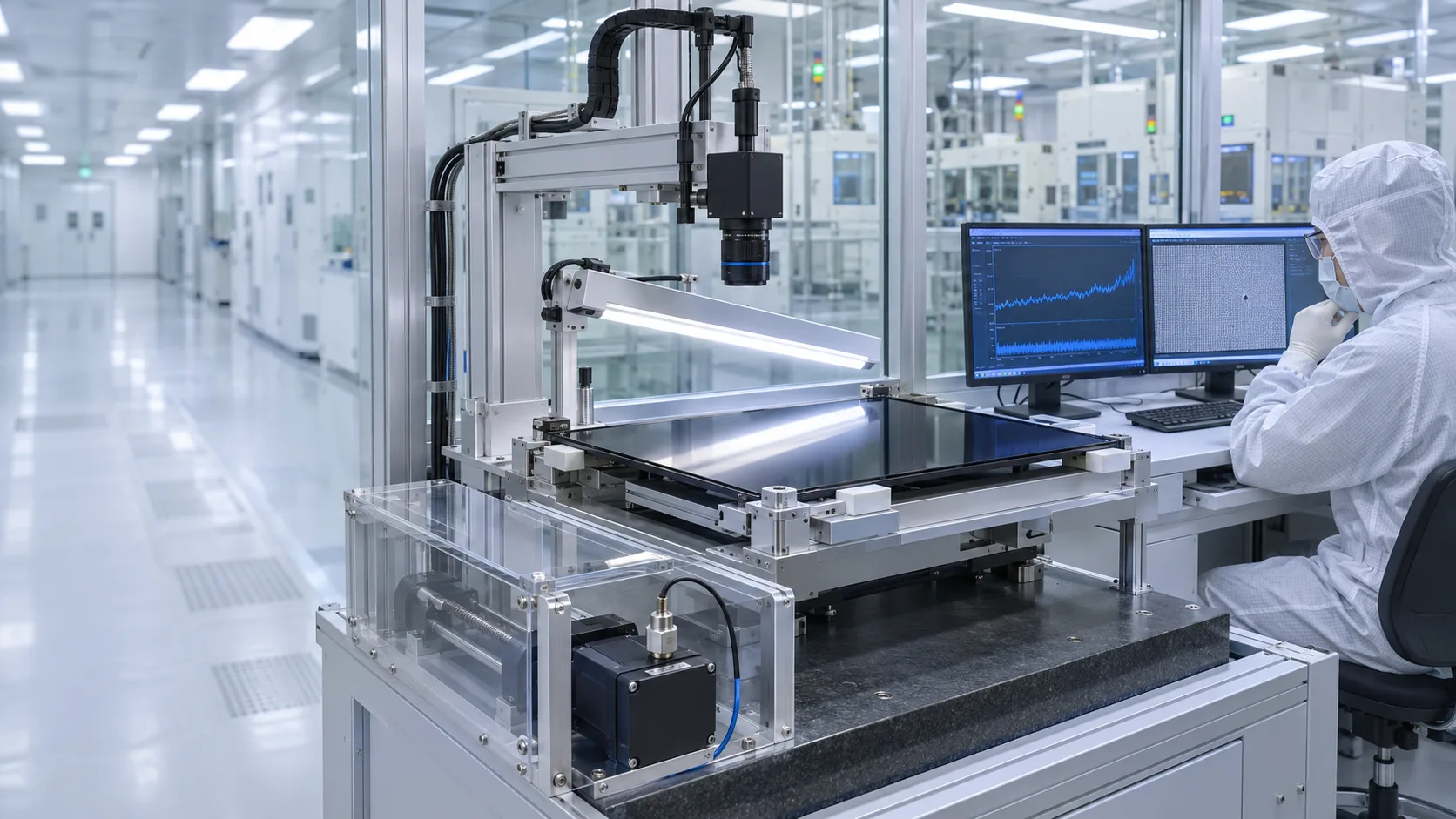
DisplayCore’s research direction examines how equipment condition data, complementary inspection signals, and process records can support better-informed maintenance and quality decisions. The work is framed around industry-specific questions, candidate methods, and measurable evaluation. Research topics described here are areas for investigation, not claims of completed deployments or validated production performance.
Research focus areas
Transferable equipment diagnostics and predictive maintenance
Display production relies on equipment such as vacuum systems, pumps, motors, precision stages, conveyors, handling mechanisms, coating and deposition equipment, and environmental-control systems. Their operating signals can change with workload, recipe, product format, and normal wear. A useful diagnostic method must distinguish these expected changes from signs of deterioration.
Research questions include: Which operating variables provide useful evidence for a particular asset? Can a diagnostic model transfer between similar machines or production lines? How should the system respond when it encounters an unfamiliar operating regime or insufficient failure history?
Candidate data may include vibration, temperature, current, pressure, flow, acoustic signals, equipment states, recipe context, alarm histories, and maintenance records. Candidate methods include condition baselines, anomaly detection, domain adaptation, physics-informed features, and failure-risk estimation. Remaining-useful-life prediction should only be attempted where asset histories and independent validation are adequate.
A bounded demonstration could train and evaluate a diagnostic approach on one equipment rig or dataset, then test it on a separate machine or held-out operating conditions. Evaluation should compare with an existing threshold or maintenance baseline and report missed faults, false alarms per operating hour, detection lead time, diagnostic accuracy, transfer performance, and uncertainty calibration.
Multimodal display inspection and defect detection
Display quality inspection can involve glass substrates, thin-film layers, coatings, encapsulation, lamination, optical surfaces, and finished panels. Defect appearance may vary with material, process stage, illumination, viewing angle, and surface finish. A single camera view may not capture every condition that matters.
Research questions include: When does thermal, depth, or another sensing modality add useful information to visible-light inspection? Can a model distinguish a relevant defect from harmless surface variation? How should inspection respond when an image is blurred, obstructed, poorly illuminated, or outside the validated range?
Candidate inputs include calibrated visible images, controlled illumination, thermal observations where physically relevant, depth information, and process context. Methods may include image-quality screening, defect classification, localization, anomaly detection, and confidence-based referral for human review. Synthetic imagery, if used for development, must be labeled and must not replace evaluation on representative real images.
A proposed demonstration could inspect a defined panel or component for a selected set of surface or assembly defects under controlled changes in lighting and presentation. Evaluation should use independently labeled test cases and report missed defects and false rejects by defect class and operating condition, localization accuracy, inspection time, and the rate of uncertain cases sent for review.
Process quality prediction and defect-cause investigation
Display quality is shaped by connected process steps rather than one isolated measurement. Material batches, equipment settings, recipe versions, environmental conditions, tool history, and handling events may all be relevant to downstream outcomes. Their records may use different timestamps, identifiers, and levels of detail.
Research questions include: Which process variables provide an early and repeatable indication of a quality risk? Can upstream information help identify a likely defect before a batch completes? Do suspected causes remain plausible when material, recipe, or equipment conditions change?
Candidate data includes material and lot identifiers, process recipes, machine settings, environmental records, tool histories, inspection outcomes, and rework or scrap classifications. Candidate methods include time-aligned feature analysis, calibrated quality prediction, interpretable models, and ranked cause hypotheses reviewed with process engineers. Correlation alone should not be presented as proof of root cause.
A bounded study could compare a candidate quality-risk model with an existing process-control or inspection baseline using a separated test period or held-out lots. Evaluation should include warning lead time, prediction calibration, false alerts, confirmed cause hypotheses, and whether a controlled process adjustment improves quality against a suitable comparison.
Structural and facility condition assessment where relevant
Some display operations depend on stable facility and installation conditions, including equipment foundations, precision platforms, support structures, cleanroom infrastructure, and vibration-sensitive environments. Changes in load, temperature, or surrounding activity can affect measurements and should not automatically be interpreted as deterioration.
Research questions include: Which measurements are useful for identifying a meaningful change in a particular structure or installation? How can normal environmental variation be separated from a condition requiring engineering review? Which sensor combinations provide enough evidence to prioritize an inspection?
Depending on the asset, candidate observations may include vibration, tilt, displacement, strain, temperature, humidity, and equipment operating state. This topic is conditional: it should be included in a project only where the facility or structural problem is relevant and suitable reference inspections are available.
A proposed test could use an instrumented test structure or an appropriately annotated monitoring dataset with controlled load and environmental changes. Evaluation may include detection sensitivity, localization, false alerts under changing conditions, uncertainty, and agreement with independent engineering inspections.
Risk-based maintenance and intervention planning
A condition alert is useful only when it helps a team decide what to do next. Maintenance planning in a display facility must account for equipment criticality, production schedules, available technicians, spare parts, planned shutdown windows, safety requirements, and the uncertainty of the diagnostic evidence.
Research questions include: Which assets should be inspected first when several alerts occur together? When is an inspection preferable to a repair or replacement? How should a recommendation change when spare parts, staffing, or production constraints change?
Candidate inputs include condition estimates, asset criticality, maintenance history, work-order status, parts availability, crew capacity, and production constraints. Candidate methods include risk ranking, constrained scheduling, scenario comparison, and uncertainty-aware prioritization. Recommendations should retain their assumptions and remain subject to the facility’s approval process.
A demonstration could replay anonymized or synthetic maintenance histories for a small asset group and compare periodic, threshold-based, and risk-based planning. Evaluation should include unplanned downtime in the modeled scenario, maintenance effort, deferred high-risk work, schedule feasibility, and sensitivity to inaccurate failure estimates. Simulated results must be labeled as simulated.
Research method and evidence standards
Each research topic should begin with a defined operational problem, a specific asset or inspection task, and a clear account of the decisions the evidence is intended to support. Data readiness should be reviewed before model selection. This includes checking asset identity, timestamps, operating context, sensor health, maintenance labels, defect definitions, inspection criteria, and missing or inconsistent records.
Development and evaluation data must be separated to prevent information leakage. Where possible, evaluation should hold out complete machines, production lots, time periods, or operating conditions rather than randomly splitting near-duplicate records. Baselines should reflect current practice, such as threshold alarms, existing inspection rules, or established maintenance routines.
Results should report both useful detections and failure cases. Relevant measures include missed faults, false alarms, warning time, defect detection and false-reject rates, calibration, transfer across machines, inspection time, and the usefulness of maintenance priorities. Uncertain or out-of-scope observations should be identified rather than forced into a confident prediction.
The status of each activity must be explicit. A proposed method, an illustrative scenario, an executed simulation using synthetic data, a controlled bench test, a customer pilot, and an operational result are different evidence levels. Simulation-derived warning time does not establish production remaining-life accuracy, avoided downtime, or customer benefit.
From research to an operational workflow
A practical workflow connects equipment and product identity with timestamped observations, quality checks, AI-supported assessment, and a reviewed operational response. For equipment health, a finding may be routed to a maintenance engineer for inspection and work-order consideration. For product inspection, a finding may be sent to a quality reviewer for confirmation, reinspection, or an approved disposition. Any control or sorting action requires validated interfaces, defined authority, and confirmation that the intended action was completed.
Feedback from inspections, repairs, and confirmed quality outcomes can improve later evaluation. That feedback must retain its provenance, including who reviewed the finding, what action was taken, and whether the condition was confirmed. Model updates should be versioned and reviewed before release into an operational workflow.
Related DisplayCore resources
Discuss a research or pilot requirement
The right starting point depends on the equipment, inspection task, available records, and the decision a team needs to improve. Contact DisplayCore to discuss a defined use case, data-readiness questions, and an evaluation plan that can be reviewed against current operating practice.