
Distributed Intelligence, Robotics, Drones, and Autonomous Vehicles Research for Display Manufacturing
Robots, drones, and autonomous mobile systems can support display manufacturing when perception, task planning, and physical execution are coordinated around the requirements of the production environment. Display manufacturing presents specific challenges: large and fragile glass substrates, contamination-controlled process areas, precise handoffs between equipment, tightly managed material routes, and production schedules that leave limited room for unplanned movement.
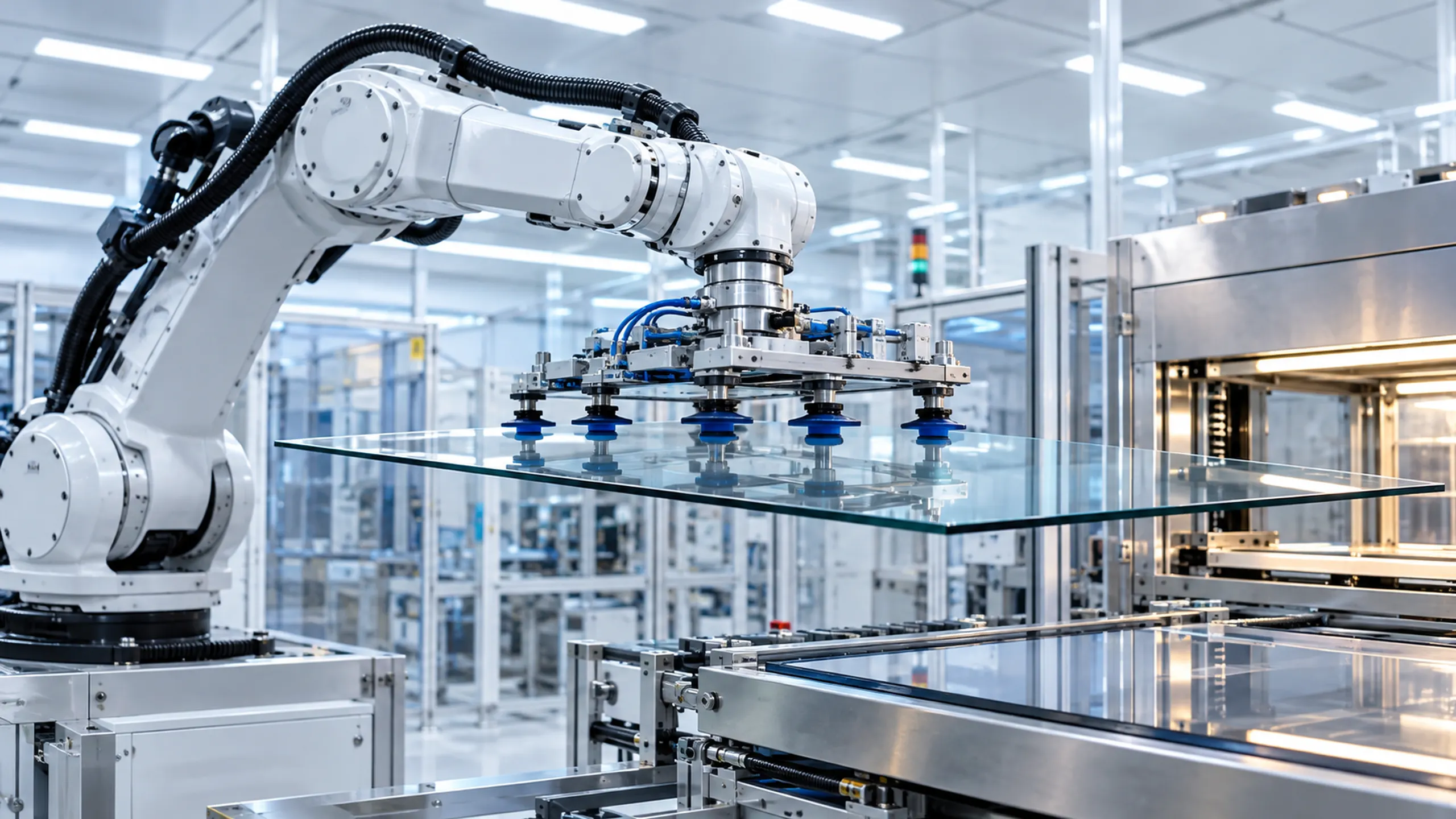
DisplayCore’s research focus is to examine how distributed intelligence could help robotic systems perform defined tasks, coordinate with one another, and recover safely when operating conditions change. Relevant work includes robotic substrate handling, machine tending, autonomous material movement, selected inspection missions, and human–robot collaboration. The value of each approach depends on the task, facility layout, equipment interfaces, data quality, and the safeguards required by the site.
Why distributed intelligence matters in display manufacturing
A display manufacturing facility moves substrates, components, carriers, tools, and maintenance materials through a sequence of process and inspection stages. A robot at one station may need to respond to equipment availability, carrier identity, upstream delays, downstream buffer capacity, and the status of nearby mobile platforms. A centralized schedule can provide coordination, but local edge processing may be useful when a robot must respond quickly to a changed obstacle, a sensor fault, or a temporary loss of network connectivity.
The research problem is not simply how to automate an individual movement. It is how to coordinate several bounded tasks while preserving substrate integrity, cleanroom rules, equipment interlocks, traceability, and human authority. Research should therefore evaluate the full workflow, from the initial observation and task assignment through execution, exception handling, and confirmation of the resulting physical state.
Robotic glass-substrate handling and machine tending
Large display glass panels require controlled support, stable motion, and carefully designed contact points. Candidate robotic tasks include transferring a panel or panel carrier between a staging position and a process tool, loading or unloading a defined station, moving an approved carrier through a buffer area, and assisting with repetitive handling around inspection or metrology equipment. The selected task must be tied to a specific substrate format, carrier design, equipment boundary, and operating environment.
Research questions include how a robot can detect panel position and orientation, confirm that a carrier is correctly presented, and adapt its motion when the observed state differs from the expected state. Candidate methods include machine vision, depth sensing where appropriate, force or vacuum monitoring, calibrated motion planning, and edge-based state estimation. End-effectors and grippers must be assessed for panel support, contact pressure, vibration, particle generation, electrostatic discharge (ESD) controls, and recovery from a failed pickup or incomplete handoff.
A useful baseline is a fixed robot sequence with defined pickup and placement coordinates. An adaptive candidate policy could incorporate current station availability, updated panel or carrier pose, and verified equipment state before continuing. The research should not assume that a model-based adjustment is suitable for every panel size or process step. Equipment-specific engineering limits and independent protective functions remain authoritative.
Autonomous material movement and production logistics
Autonomous mobile robots (AMRs) and automated guided vehicles (AGVs) may support movement of approved panel carriers, component containers, maintenance kits, and production supplies between designated staging points. For display manufacturing, route planning must account for aisle width, floor condition, traffic separation, lift and door interfaces, charging locations, cleanroom transitions, and the handling rules for each carrier. A route that is efficient in an open warehouse may not be acceptable inside a controlled process area.
Distributed scheduling research can examine how multiple mobile platforms share routes and respond to changing demand. A dispatch decision may consider production priorities, destination buffer capacity, robot battery state, carrier identity, equipment readiness, and temporary route restrictions. The system should distinguish a requested transfer from a completed transfer. Confirmation can use a combination of robot status, location observations, carrier identification, and receiving-station acknowledgment.
Relevant integration points may include manufacturing execution systems (MES), warehouse management systems (WMS), equipment controllers, fleet-management software, and maintenance applications. These are potential interfaces, not claims of existing DisplayCore connectors. Before a pilot, the project team should define data ownership, identifiers, timestamps, message timing, command permissions, and recovery behavior for delayed or duplicated events.
Drone-based inspection and adaptive sensing
Drones may have a limited role in display manufacturing where a camera-equipped aircraft can inspect approved facility areas that are difficult or inefficient to reach using fixed inspection methods. Candidate settings include roof structures, selected utility corridors, high-bay storage, exterior infrastructure, and other areas specifically approved by facility safety and engineering teams. Drone use inside cleanrooms or near exposed substrates should not be assumed: rotor airflow, particle generation, electrostatic discharge, collision risk, and process contamination may make flight unsuitable.
Research questions include how a drone can localize itself in a changing indoor or semi-enclosed environment, plan a safe inspection route, avoid obstacles, and adapt image capture to lighting and visibility. A proposed mission should define no-fly zones, minimum clearances, emergency landing areas, communication-loss behavior, and the conditions under which an operator must take control. Navigation performance and inspection quality must be evaluated separately. Reaching a waypoint does not establish that a defect, leak, or equipment condition was correctly identified.
Multi-agent coordination, edge processing, and human oversight
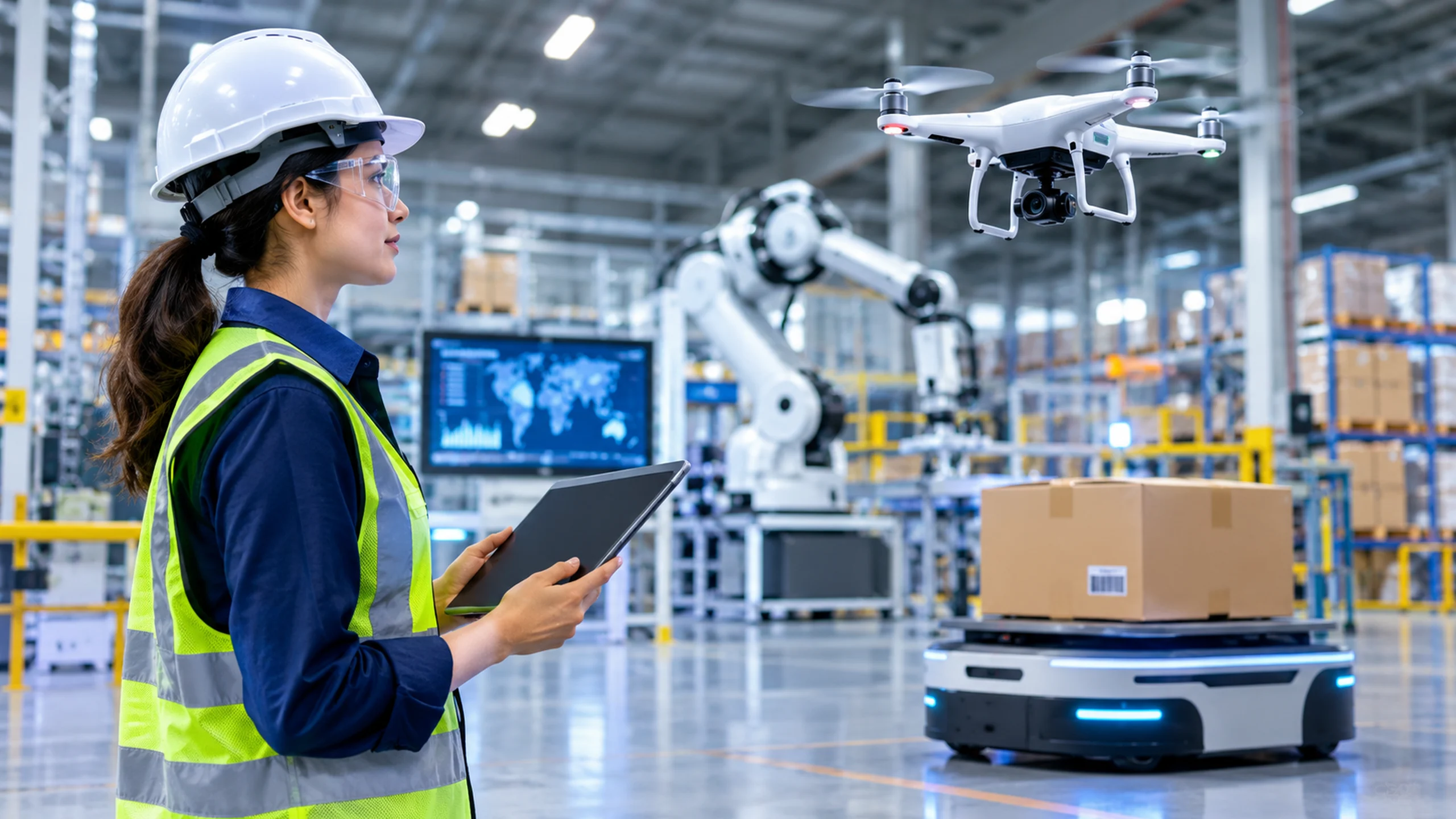
A coordinated workflow may involve a fixed industrial robot, one or more AMRs, an inspection drone operating in an approved area, and human operators responsible for exceptions. Distributed intelligence research examines which decisions should be made locally and which require coordination across the facility. Local edge processing may support obstacle response, pose updates, and short-horizon motion adjustments. Fleet-level services may assign jobs, manage shared resources, and resolve competing priorities. The architecture should define how each node reports its state and how the system behaves when a node becomes unavailable.
Human–robot collaboration requires clear task boundaries and usable intervention procedures. Operators should be able to see the task objective, the asset or carrier involved, the current operating state, and the reason for a pause or escalation. A robot should not continue from stale observations or execute an old command after the task context has changed. Human approval, manual recovery, and emergency stop functions must remain available as required by the equipment and site risk assessment.
Research questions and candidate methods
- Distributed scheduling: How should work be assigned across fixed robots, AMRs, and approved inspection platforms when production priorities, buffers, and equipment availability change? Candidate methods include rule-based dispatch, multi-agent scheduling, and constrained optimization.
- Resilient edge intelligence: Which perception and motion decisions should remain local during network degradation, and what information must be synchronized when connectivity returns? Candidate methods include local state estimation, event buffering, and bounded replanning.
- Adaptive manipulation: How can a robot detect an uncertain panel pose, incomplete pickup, or unexpected resistance and pause or recover without exceeding approved motion and force limits? Candidate methods include vision-guided alignment, force or vacuum feedback, and guarded recovery states.
- Human–robot collaboration: Which tasks are suitable for automatic execution, which require human approval, and how should operators receive actionable explanations when the system abstains or escalates? Candidate methods include permission-aware task planning and explicit intervention states.
- Drone mission planning: Which facility areas can be inspected safely by an aerial platform, and how do localization uncertainty, lighting, occlusion, and communications affect route completion and image coverage? Candidate methods include visual localization, obstacle mapping, and adaptive sensing plans.
- Fleet recovery: How should a system respond to blocked aisles, unavailable stations, low battery, localization loss, delayed acknowledgments, or a platform that stops reporting? Candidate methods include safe stop, task reassignment, route replanning, and independently confirmed recovery.
Data and platform requirements
A credible evaluation needs time-aligned records for the physical task and the system decisions around it. Depending on the selected workflow, relevant data may include robot and carrier identifiers, panel or carrier format, station identity, observed pose, operating mode, task priority, route segment, obstacle state, battery state, sensor quality, command identifier, authorization outcome, acknowledgment time, and independently observed completion state. Data collection should distinguish the true or independently verified state from the observations available to the candidate method.
Platform requirements may include a representative robot or AMR, suitable grippers and fixtures, cameras or other approved sensors, edge compute, a fleet or task scheduler, and interfaces to the relevant equipment or production systems. The exact bill of materials and interface set must be selected for the chosen process. Named protocols, robot brands, and controller families should be treated as options until compatibility is tested and approved.
Proposed demonstration and evaluation
A practical first study could model the transfer of a fictional display-panel carrier between two production cells and a buffer station. The model would represent carrier identity, station availability, robot position, route occupancy, task priority, and communication delay. It would include normal operations and degraded cases such as a blocked route, stale location estimate, unavailable receiving station, low battery, duplicate dispatch, missed carrier observation, and failed or partial transfer.
The baseline could use fixed routes and static task priorities. A candidate method could use updated station and route state to reassign tasks or select a feasible alternative path. Both methods should be evaluated against matched demand and disturbance scenarios. If suitable equipment is available, a controlled test area could then assess a bounded carrier movement using a non-production test load before any work involving actual display glass.
Evaluation should report the test conditions, run count, data provenance, assumptions, and limitations. No numerical performance result should be published until it has been calculated from saved outputs and reviewed. Simulation results must not be presented as production performance or as evidence of a completed customer deployment.
| Measure | What it evaluates | Important qualification |
|---|---|---|
| Task completion | Share of eligible tasks completed and independently confirmed. | Separate successful completion from command acknowledgment. |
| Transfer accuracy | Correct carrier, source, destination, and handoff association. | Define the ground-truth event and acceptable location tolerance. |
| Localization error | Difference between estimated and reference platform position. | Report by operating condition and degraded-sensing case. |
| Coverage and inspection quality | Area or assets observed, plus separately assessed inspection findings. | Navigation coverage does not establish defect-detection quality. |
| Energy use and cycle time | Energy per task and elapsed time from dispatch to verified completion. | State load, route, charging assumptions, and operating window. |
| Constraint violations | Incidents involving restricted zones, clearance, interlocks, or motion limits. | Any critical violation requires engineering review, not averaging away. |
| Interventions and recovery | Operator interventions, safe stops, replanning time, and recovery success. | Group repeated alerts and define what counts as an intervention. |
| Communication resilience | Behavior during latency, packet loss, outage, and stale messages. | Test safe local behavior and controlled resynchronization. |
The study should compare a simple, credible baseline with the candidate method and include conditions where the candidate provides little benefit or performs worse. Report distributions and uncertainty across independent runs. If a physical reference is unavailable, describe the review as plausibility checking rather than field validation.
Limitations and research status
This page describes a DisplayCore-specific research adaptation and proposed evaluation directions. It does not claim that DisplayCore has completed a robotics breakthrough, operates a separate robotics research team, deployed a coordinated robot fleet, completed a customer pilot, or offers a commercial drone or autonomous-vehicle product. The current implementation status of each platform, interface, and demonstration must be confirmed by the technical owner before publication or use in a sales discussion.
The broader shared research initiative is attributed to Aperture Venture Studio, GAO RFID Inc., and GAO Tek Inc., and uses the name Aperture Physical AI Research Labs where applicable. This page applies that shared research context to display manufacturing. It should not be read as evidence that DisplayCore maintains a separate research laboratory or that every topic listed is active. Company-specific staffing, completed experiments, and measured results require separate verification.
Key limitations include differences among display panel sizes and process flows, facility-specific contamination and safety controls, sensor performance under actual lighting and occlusion, equipment-interface availability, and the difficulty of transferring a policy between sites. A simulation can help compare methods under stated assumptions, but it cannot establish cleanroom suitability, safe physical deployment, or production performance without controlled physical validation.
Related research and technical resources
Explore related DisplayCore resources for the engine functions, control technologies, and system interfaces that may support a defined robotics workflow:
Discuss a display-manufacturing workflow, its operating constraints, and the evidence needed for a controlled evaluation with the DisplayCore team.