
Physical AI and AIoT Engines for Display Manufacturing
Display manufacturing depends on coordinated control of materials, production equipment, process conditions, and quality requirements. From glass substrates and thin-film processes to cell assembly, module production, and final inspection, each stage creates operational data that must be connected to the right asset, product, process, and time.
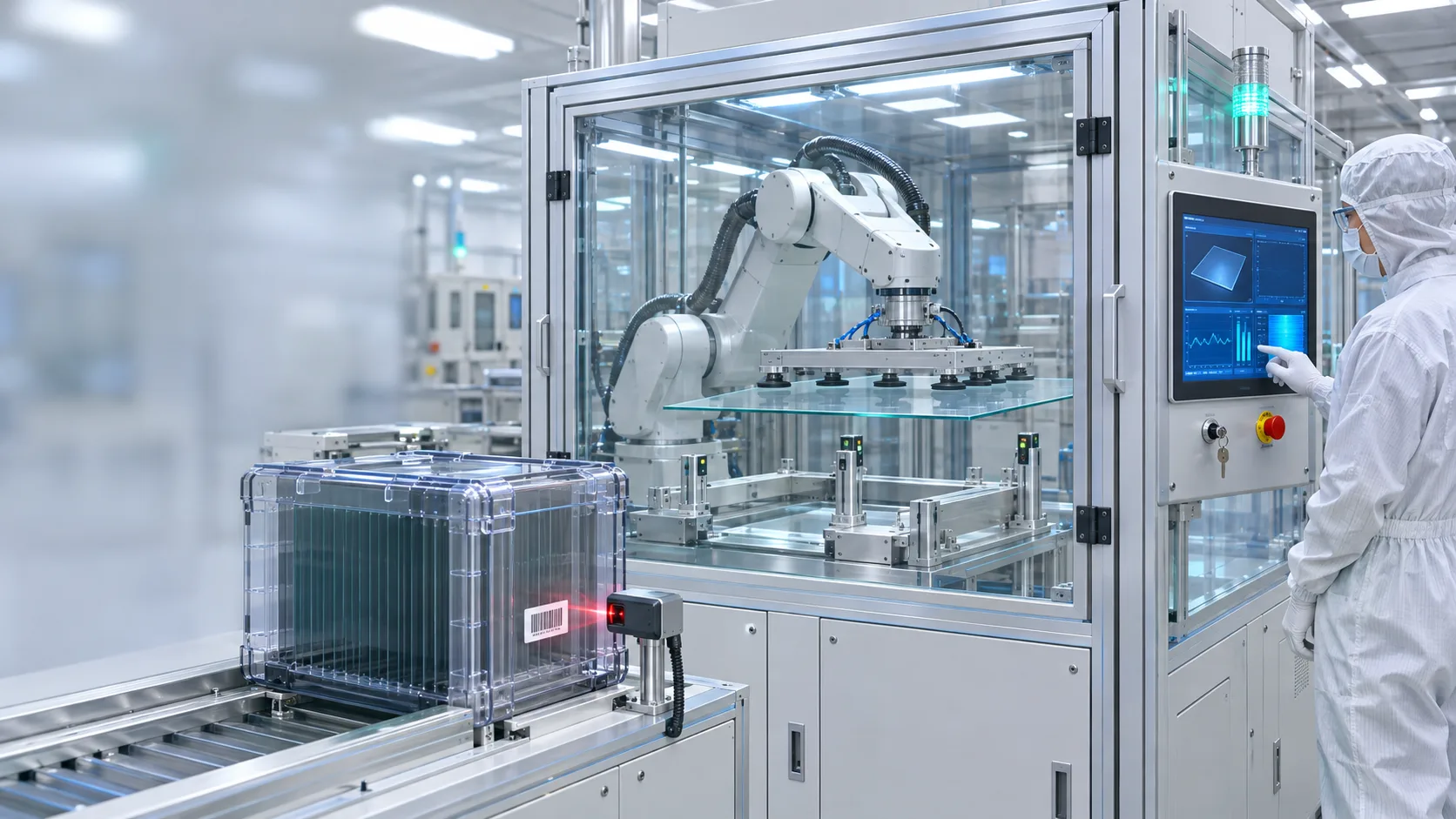
DisplayCore’s Physical AI and Artificial Intelligence of Things (AIoT) approach organizes this work into connected engine functions. Identification establishes what is being observed. Sensing captures relevant physical and process conditions. AI analyzes the information and supports decisions. When a workflow requires a physical response, the Physical AI configuration adds an action function that connects an authorized decision to an equipment or operational interface.
The architecture provides a way to define an application and its system boundaries. The specific devices, models, integrations, control interfaces, and deployment arrangement must be selected and validated for the facility and production process.
Two Configurations, One Connected Workflow
AIoT: Identify, Sense, and Decide
The three-engine AIoT configuration combines the Identification Engine, Sensing Engine, and AI Decision Engine. It connects physical-world observations with operational context and decision support. For example, a production team could associate a substrate or display panel with its process history, collect relevant equipment or environmental measurements, and review an alert or recommendation when the observed conditions differ from an established operating baseline.
AIoT can support visibility, monitoring, traceability, and decision workflows without directly controlling machinery. Outputs may include event records, dashboards, alerts, quality-review requests, or recommendations for an authorized employee.
Physical AI: Identify, Sense, Decide, and Act
The four-engine Physical AI configuration adds the Physical AI Action Engine to the three AIoT functions. It extends the workflow from information and decision support to a defined physical response. Depending on the application and validated interfaces, that response could involve routing a review task, requesting an authorized equipment adjustment, or initiating a bounded movement or control sequence.
Physical action requires a defined target, command path, authority, operating limits, equipment interface, fallback behavior, and method for confirming the resulting physical state. Independent equipment protections and existing safety systems remain authoritative.
The Four Engines
Identification Engine: Establishing Asset and Product Identity
The Identification Engine associates observations and events with the correct object, equipment item, or production record. In display manufacturing, relevant identification subjects may include glass substrates, mother glass, panels, cassettes, carriers, masks, tools, production lots, and work in progress.
Depending on the physical environment and required read performance, an identification design may evaluate radio-frequency identification (RFID), barcode or two-dimensional code scanning, Bluetooth Low Energy (BLE), ultra-wideband (UWB), or machine vision. These are technology options, not blanket compatibility claims. Selection depends on line layout, material handling, tag or label suitability, reader placement, electromagnetic conditions, visibility, and the required level of location detail.
The engine’s output is an identity-linked event or association that downstream functions can use. Missed reads, duplicate observations, stale timestamps, and uncertain associations should be identified rather than treated as confirmed movement.
Sensing Engine: Capturing Process and Equipment Conditions
The Sensing Engine captures measurements that describe equipment state, process conditions, and relevant production environments. Depending on the selected display process, candidate measurements may include temperature, pressure, vibration, electrical characteristics, humidity, particle or environmental conditions, flow, and visual or thermal observations.
A measurement becomes useful when it is tied to the correct equipment or product, timestamp, operating mode, unit, and sensor-quality status. Sensor range, placement, sampling interval, calibration, drift, missing readings, and connectivity all affect whether the data is suitable for analysis. Measured values must also be distinguished from inferred conditions.
The output is a time-aligned set of measurements and quality indicators that can support trends, alerts, process review, and AI analysis.
AI Decision Engine: Turning Operational Data into Useful Decisions
The AI Decision Engine evaluates identification events, sensor measurements, production context, historical records, and applicable business or process rules. Depending on available data and the defined use case, candidate functions may include anomaly detection, condition assessment, defect classification, trend analysis, risk prioritization, forecasting, and operational recommendations.
For display manufacturing, an evaluation might examine whether equipment measurements depart from a reviewed baseline, whether an inspection image should be sent for quality review, or whether a product’s recorded process history contains an exception requiring investigation. Outputs should identify the information used, the decision or recommendation, uncertainty where applicable, and the next responsible workflow.
A model output is not automatically a validated diagnosis or authorization to control equipment. Performance must be assessed against representative data, a credible baseline, defined acceptance criteria, and the operating conditions in which the result will be used. When data is stale, incomplete, outside evaluated conditions, or insufficiently reliable, the system should support escalation or abstention.
Physical AI Action Engine: Connecting Authorized Decisions to Action
The Physical AI Action Engine provides the functional path from an approved decision to an operational response. Depending on the application, the path may involve a human-mediated task, a human-approved command, or bounded automated execution through a validated equipment interface.
In a display facility, a proposed workflow could route a suspect panel for additional inspection, request an authorized material-handling movement, or submit a bounded equipment adjustment for approval. Direct equipment control requires site-specific engineering review, interface testing, permissions, interlocks, independent protective functions, and a defined manual override or recovery path.
A command acknowledgment confirms that a command was received or processed. Confirm the physical outcome separately using independent evidence, such as a subsequent sensor measurement, equipment state, position observation, or confirmed production event.
How the Engines Apply to Display Manufacturing
The following conceptual scenarios illustrate how the engine functions can be combined. Confirm the availability and implementation status of specific integrations and request reviewed evidence for any reported deployment or performance result.
Substrate and Panel Traceability
A substrate or panel receives an identity that can be associated with production events at selected process and handling points. Identification observations are linked to timestamps and relevant manufacturing records. The AI Decision Engine can help flag missing, duplicate, delayed, or inconsistent events for review. The practical evaluation should measure event completeness, incorrect associations, unresolved transfers, reconciliation effort, and the effect of reader or network coverage.
Configuration: AIoT. The core workflow uses identification, sensing, and decision support.
Equipment and Process Condition Monitoring
Measurements from selected production equipment or its surrounding environment are associated with equipment identity and operating mode. The AI Decision Engine can compare current observations with reviewed thresholds or historical patterns and route exceptions to the responsible engineering or maintenance team. A pilot should assess sensor suitability, data availability, false-alert frequency, detection delay, missing-data behavior, and the usefulness of the resulting review workflow.
Configuration: AIoT. Any subsequent equipment adjustment would require a separately defined and authorized action path.
Visual Quality Inspection Support
Images or other inspection measurements from a defined display component or production stage can be associated with the relevant product and inspection context. An AI assessment may help classify candidate surface or appearance anomalies and direct uncertain findings to human review. Defect categories, image capture conditions, representative labeled samples, false accepts, false rejects, and inspection repeatability must be evaluated before performance claims are made.
Configuration: AIoT for assessment and review routing. A physical sorting or handling response would require a validated Physical AI action workflow.
Authorized Material or Equipment Response
When an operational exception requires a physical response, the decision can be presented for authorization and passed to a defined equipment or material-handling interface. The workflow records the target, requested action, approval, command status, and subsequent evidence of the result. Evaluation should include rejected commands, communication failures, manual overrides, incomplete execution, recovery behavior, and independently verified outcomes.
Configuration: Physical AI, provided the action interface and safeguards have been engineered and validated for the specific facility.
Engine Input and Output Summary
| Engine | Display manufacturing input | Functional output | Example application |
|---|---|---|---|
| Identification | Substrate, panel, carrier, cassette, equipment, or lot identifiers and reader or scan events | Identity-linked events and associations with quality indicators | Panel or substrate traceability |
| Sensing | Equipment, process, environmental, visual, or thermal measurements | Time-aligned measurements, condition indicators, and quality flags | Equipment or process monitoring |
| AI Decision | Identity-linked events, sensor data, production context, history, and rules | Alerts, classifications, priorities, forecasts, or recommendations | Exception review or inspection support |
| Physical AI Action | Authorized decision, target, constraints, permissions, and validated interface | Command or task execution record plus independently checked outcome | Approved routing, handling, or equipment response |
From Engine Functions to a Facility Workflow
Start with a defined production question. The project team should identify the equipment or product boundary, the event or condition to observe, the people responsible for decisions, the available data, and the operational result that can be measured.
- Define the workflow. Select a production stage, asset class, inspection task, or material movement and document the current process.
- Map the information. Identify product and equipment identifiers, sensor sources, timestamps, operating modes, quality records, and relevant manufacturing systems.
- Choose the configuration. Use the three-engine AIoT workflow when identification, sensing, and decision support meet the need. Add the Physical AI Action Engine only when a defined and authorized physical response is required.
- Assess integration and deployment. Determine device and network requirements, edge or server processing needs, system interfaces, data ownership, cybersecurity controls, and outage behavior.
- Evaluate against a baseline. Define representative test conditions, acceptance criteria, data-quality checks, false-alert or error measures, user review requirements, and physical verification where actions are involved.
- Document maturity. Distinguish proposed designs, implemented demonstrations, controlled tests, customer pilots, and operational results. Label conceptual scenarios as proposed.
Architecture, Integration, and Operational Boundaries
The engines describe functional responsibilities. Select the hardware and deployment model for the application. Identification devices and sensors may connect through local gateways or other edge equipment. Data processing and AI functions may run at the edge, on customer-managed infrastructure, or in a cloud environment when the security, latency, availability, and data-governance requirements permit.
Integration planning should identify the systems that own production, quality, maintenance, and equipment records. Relevant interfaces may include manufacturing execution systems (MES), enterprise resource planning (ERP), computerized maintenance management systems (CMMS), supervisory control and data acquisition (SCADA), programmable logic controllers (PLCs), and equipment-specific interfaces. Confirm connector availability for each system.
Before implementation, confirm data formats, identifiers, timestamp handling, permissions, network segmentation, retention, audit requirements, device maintenance responsibilities, and recovery procedures. For any physical action, document command authority, operating limits, independent safeguards, manual override, failure handling, and the method used to verify the resulting state.
Explore the Engine Components
Explore each engine to understand its role, inputs, outputs, and implementation considerations.
For broader solution context, visit DisplayCore Solutions ↗ and Applications ↗.
Discuss a Display Manufacturing Application
Every display manufacturing environment has its own equipment, process sequence, data sources, quality requirements, and control boundaries. Discuss the production workflow you want to improve, the information already available, and the operational decisions that need better support. DisplayCore can use that discussion to define the relevant engine functions, integration questions, evaluation criteria, and next steps.