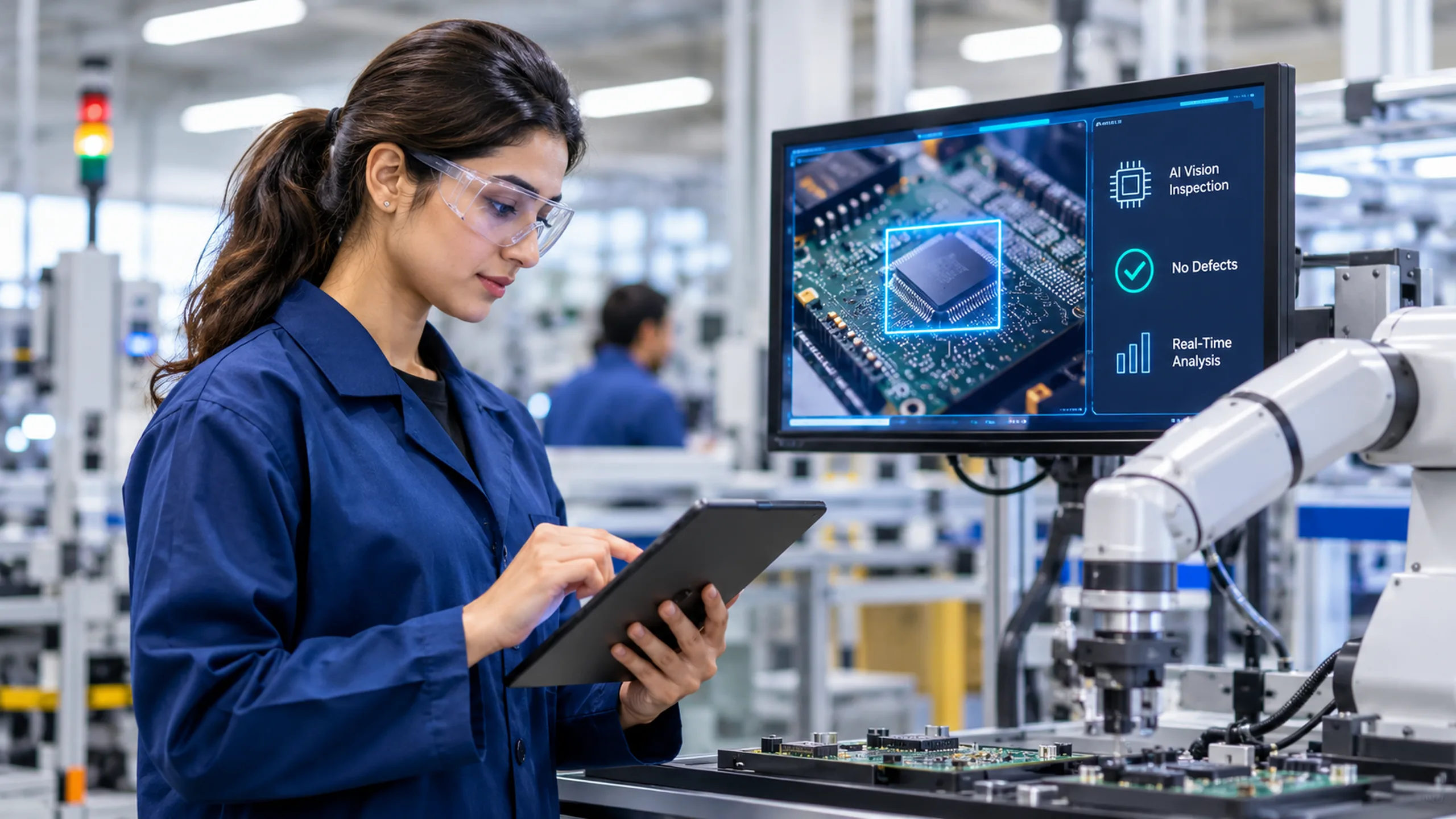
Physical AI and AIoT FAQs for Display Manufacturing
Explore common questions about applying Physical AI and Artificial Intelligence of Things (AIoT) to display manufacturing. Learn which data, equipment, integration, and evaluation requirements determine whether an approach fits a particular operation. Display manufacturing includes processes such as glass substrate handling, thin-film deposition, photolithography, cell assembly, OLED or LCD processing, module assembly, and final display inspection. Each workflow has different sensing needs, production constraints, and quality criteria.
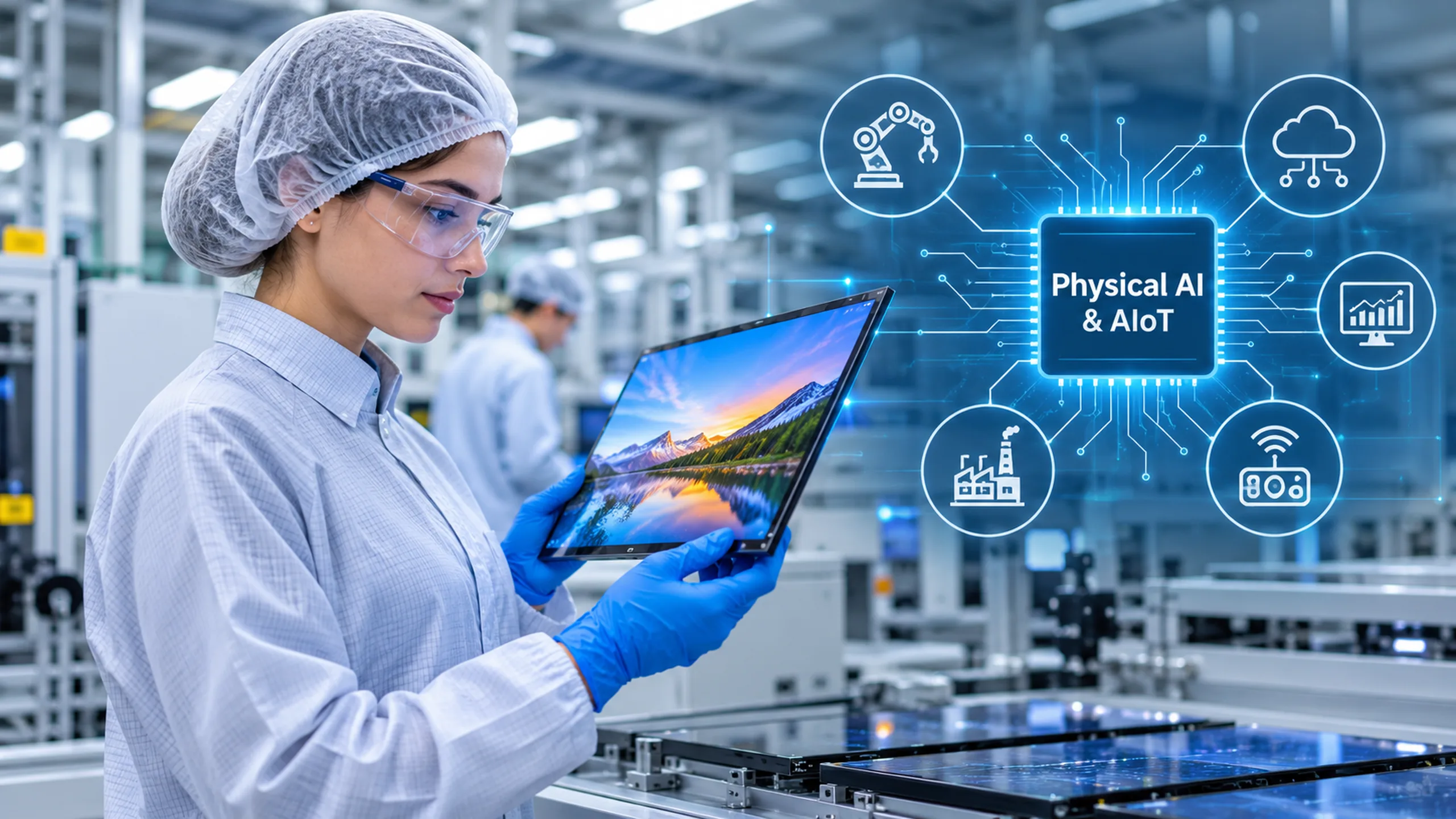
What are Physical AI and AIoT in display manufacturing?
AIoT connects sensors, equipment, and operational data with software that analyzes physical conditions. Physical AI extends this relationship by connecting AI-supported decisions to authorized actions in the physical environment. In a display facility, relevant examples may include collecting process measurements, associating inspection findings with a panel or lot, identifying anomalies, recommending a quality review, or proposing an approved equipment response. These examples illustrate potential applications. Confirm the implementation status of each function with DisplayCore.
How can these technologies support display production?
Potential applications include monitoring process equipment, tracking glass panels and work in process, analyzing inspection images for surface or pattern defects, correlating quality results with process conditions, and helping teams prioritize maintenance or review. A useful design begins with a defined production question, such as whether a measurement change is associated with an increase in panel defects. The selected system should make its inputs, decision output, responsible user, and verification method clear.
Frequently Asked Questions
1. What is the difference between AIoT and Physical AI?
AIoT links physical devices and measurements to software analysis and decision support. Physical AI also includes an authorized action path, such as a bounded equipment adjustment or robotic task, with safeguards and checks of the resulting state. A dashboard recommendation alone is not direct physical control.
2. Which display manufacturing workflows are relevant?
Examples include glass substrate and panel handling, deposition and coating equipment monitoring, photolithography process observation, OLED and LCD cell processing, module assembly, and automated optical inspection. The appropriate use case depends on the specific line, equipment, defect classes, and quality requirements. Semiconductor wafer fabrication and PCB manufacturing have distinct process boundaries and should not be assumed to share the same workflow.
3. What data is typically needed?
Depending on the task, useful inputs may include equipment and panel identifiers, lot or recipe context, timestamps, operating mode, process measurements, sensor-health indicators, inspection images, defect labels, maintenance records, and quality outcomes. Data should have consistent units and time references and be associated with the correct equipment or product. The minimum data set must be established for the selected use case.
4. What identification and sensing technologies may be used?
Identification can use barcode, RFID, or other site-appropriate methods to associate panels, lots, tools, and events. Sensing may include temperature, pressure, vibration, electrical measurements, environmental variables, or machine-vision imaging. Selection depends on the measurement range, accuracy, placement, cleanroom conditions, sampling needs, access, and maintenance requirements. No single technology is suitable for every display process.
5. Can Physical AI and AIoT work with existing manufacturing systems?
They may be integrated with existing manufacturing execution systems (MES), enterprise resource planning (ERP), equipment controllers, quality management applications, or maintenance systems when suitable interfaces and permissions are available. Integration requires an agreed data contract, identifier mapping, timestamp handling, error management, and ownership of records. Confirm compatibility with specific systems and protocols during the technical assessment.
6. Should processing run at the edge, on a local server, or in the cloud?
The choice depends on response time, network reliability, data governance, compute requirements, and who will operate and maintain the system. Edge processing may be appropriate for time-sensitive or connectivity-dependent tasks. Local servers or cloud services may support centralized analysis and cross-line reporting. A hybrid arrangement can separate local functions from remote analytics. Plan outage behavior and data recovery in advance.
7. Does AI automatically control display manufacturing equipment?
No. AI output may be informational, advisory, or an action proposal requiring approval. Any physical action needs a defined target, authorized command interface, operating limits, independent protective functions where required, override behavior, and a way to verify the physical result. Safety and equipment control remain subject to engineering review and site procedures.
8. How should a pilot be scoped and evaluated?
Start with one operational question, a bounded process or equipment class, the users involved, and a documented baseline. Define the data sources, test conditions, acceptance criteria, and metrics before the pilot begins. Depending on the workflow, measures may include inspection defect recall, false accepts and rejects, event completeness, alert rate, detection delay, review workload, or verified action outcomes. Include normal operation, exceptions, missing data, outages, and recovery. Document limitations and decide whether to expand, revise, or stop.
9. Are examples or results on this page actual customer deployments?
The examples on this page explain possible applications and do not claim customer deployment or measured operational results. Any study should clearly identify its evidence type and implementation status. Simulation results describe performance under modeled conditions. Production performance requires evidence from the facility.
10. What data is synthetic, and what must be tested at our facility?
Synthetic data is generated for a modeled scenario rather than collected as an operational record from a customer facility. It can support method development or scenario testing. A facility evaluation should verify data quality, equipment interfaces, process variation, defect prevalence, network behavior, operator workflow, safeguards, and the feasibility of the proposed response using authorized site-specific data.
11. What has DisplayCore implemented?
The status of a specific technology, integration, or action workflow should be confirmed during a technical discussion. Document each capability as proposed, demonstrated, tested, piloted, or deployed within a stated scope.