
Monitor equipment condition across display manufacturing operations
Display manufacturing depends on tightly controlled equipment and repeatable process conditions. A change in a pump, motor, chamber, or supporting utility can affect equipment availability and may require an engineering review before production continues. Condition monitoring gives operations and maintenance teams a structured way to observe selected equipment, compare measurements with operating baselines, and investigate changes that may warrant inspection.
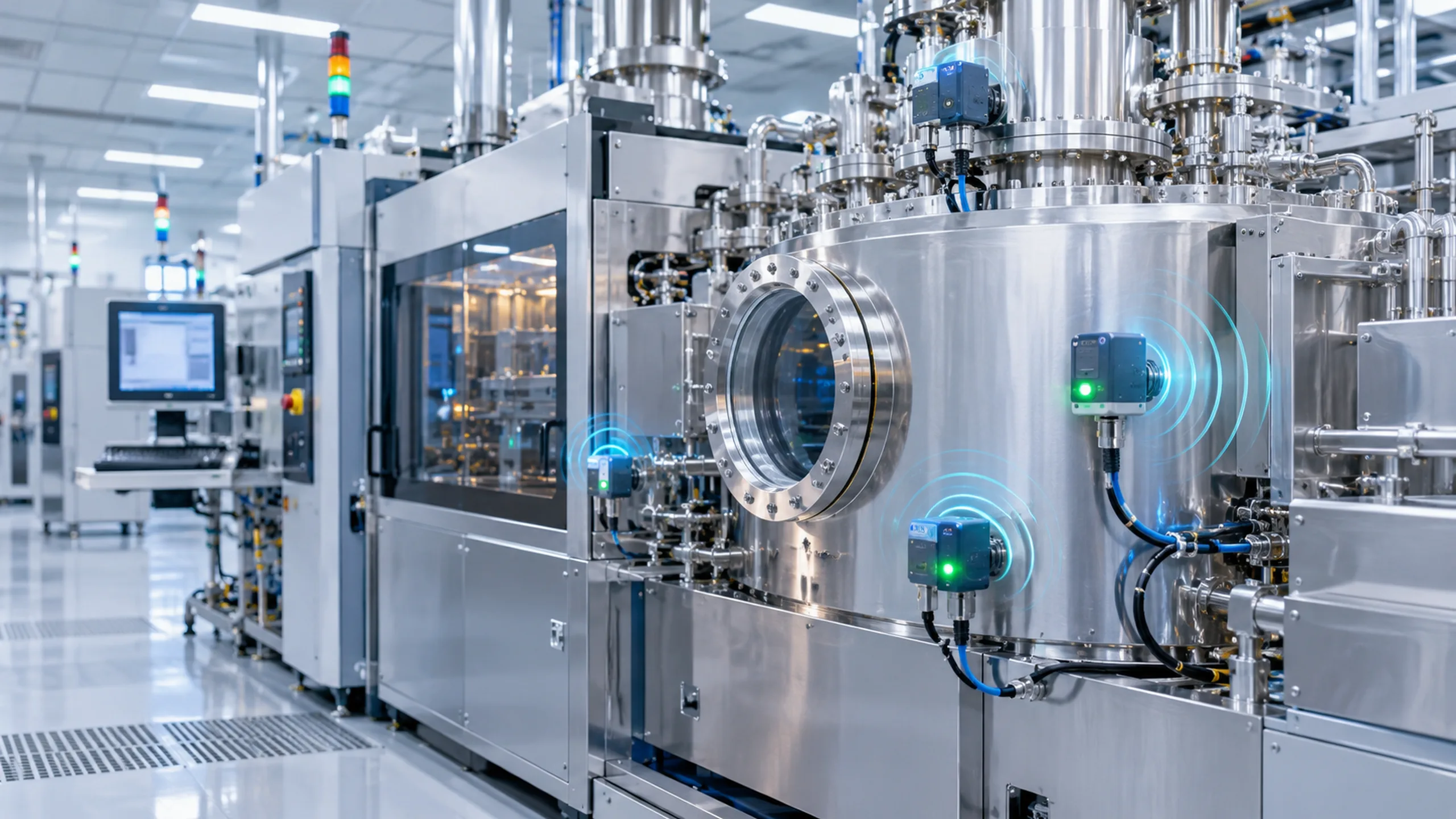
For a practical starting point, consider a process-tool vacuum system or a motor-driven subsystem supporting a display fabrication process. The monitoring scope should be defined around a specific asset, its operating modes, the measurements that can be collected reliably, and the decisions that authorized personnel need to make. The application is not a substitute for equipment interlocks, process controls, or established safety procedures.
Choose the equipment and measurements that matter
A useful monitoring plan begins with the physical question. Is the team looking for a change in rotating equipment behavior, a thermal shift, unstable vacuum performance, or a condition that appears only during a particular tool state? The selected asset may be a vacuum pump, exhaust or abatement subsystem, chiller, fan, motor, or process chamber assembly. Scope any deployed pilot to one clearly defined asset class so the evaluation reflects how that equipment actually operates.
Depending on the equipment and the available interfaces, candidate measurements may include vibration, bearing or motor temperature, motor current, vacuum pressure, pressure stability, flow, and equipment state. These are examples for engineering review, not a universal sensor specification. Each variable needs an appropriate range, unit, sampling interval, measurement location, expected uncertainty, and relationship to a maintenance or process decision.
Sensor placement must account for equipment design, access, cleanroom requirements, vibration transmission, heat, electrical noise, maintenance access, and vendor restrictions. Calibration status, timestamp quality, missing samples, sensor drift, and changes in operating mode should be recorded alongside the measurements. Raw signals should remain distinguishable from derived features such as vibration bands, trends, deviations from baseline, or rate-of-change indicators.
Baselines by operating state
A baseline should be established for relevant operating states, including startup, steady operation, idle, recipe or load changes where applicable, and shutdown. A single threshold may be misleading when normal measurements vary with tool state. Baselines and alert limits should be reviewed by equipment and process specialists and should not be presented as validated until they have been tested against representative operating data.
Turn measurements into a reviewed maintenance decision
Condition data becomes operationally useful when it is connected to equipment identity, operating state, prior measurements, inspection findings, and maintenance history. A decision workflow can compare current observations with an approved baseline, identify a deviation, check whether the tool was operating under comparable conditions, and route the result for review. The system should preserve the underlying measurement and the reason an alert was raised so that an engineer can assess the evidence.
An abnormal-condition review may consider persistence, rate of change, combinations of measurements, known process transitions, sensor quality, and recent maintenance activity. A brief vibration increase during startup may require a different response from a sustained change during steady operation. Missing or questionable measurements should be marked as uncertain rather than silently treated as normal.
Alerts should support a defined response path. Depending on severity and local procedures, the next step may be continued observation, an operator check, a maintenance inspection, or escalation to the equipment owner. Maintenance prioritization should consider the condition evidence, production context, safety and quality implications, access windows, spare-part availability, and the cost of an unnecessary intervention. Any equipment adjustment or shutdown remains subject to the site’s authorization and control procedures.
Connect equipment identity, measurements, and maintenance records
Every observation should be associated with a stable equipment identifier and, where relevant, a tool, subsystem, component, location, and timestamp. The record should connect the measurement source to the operating state, data-quality status, alert or finding, reviewer, and resulting action. Linking condition history with inspection reports and maintenance work orders helps teams understand whether a signal preceded a confirmed issue, followed a repair, or changed after an operating adjustment.
Integration may involve existing equipment interfaces, sensor gateways, manufacturing or maintenance records, and approved data services. The actual connection method depends on the tool vendor, site architecture, network segmentation, data permissions, and the availability of trustworthy timestamps and asset identifiers. Confirm any named equipment integration or real-time data connection for the specific site and tool.
Keep raw measurements, derived features, alert decisions, and human-confirmed findings as separate record types. This distinction supports traceability and allows an engineer to investigate whether an apparent anomaly came from the equipment, the operating context, or the measurement chain.

Validate detection quality before estimating business impact
A pilot should begin with representative equipment and operating states. Include normal operation, known process transitions, planned maintenance, sensor disconnection or drift, missing observations, and reviewed examples of abnormal behavior where available. Test whether the monitoring method detects the conditions it is intended to identify without creating an unacceptable volume of false alerts.
Evaluation should compare the candidate method with the site’s current inspection or monitoring practice. Relevant measures may include detection recall for confirmed conditions, false-alert rate, missed events, detection delay, alert review workload, inspection confirmation rate, and the proportion of observations that pass data-quality checks. Report the number and type of confirmed cases used in the evaluation. Separate realistic-prevalence results from deliberately enriched challenge tests.
A simulation can help examine operating states, abnormal patterns, measurement artifacts, and response workflows before a live pilot. Simulation results must be labeled as simulated and should not be presented as field performance. A later pilot should verify sensor installation, data coverage, baseline stability, alert interpretation, maintenance response, and integration behavior under actual display-fab conditions.
Financial or production effects should be estimated only after detection and data-quality performance have been established. Any estimate of avoided downtime, improved availability, or reduced maintenance effort needs explicit assumptions, a credible baseline, and review by the relevant operations and finance owners.
What equipment condition monitoring can support
When measurements are reliable and the response process is defined, condition monitoring can help display manufacturers identify changes earlier, focus inspections, prioritize maintenance work, and build a more complete history of equipment behavior. The value depends on the selected asset, sensor suitability, data quality, operating context, and the ability of the maintenance team to act on the findings.
The objective is to give equipment and maintenance teams relevant evidence, a clear account of uncertainty, and a reviewable path from observation to action.
Frequently asked questions
Which display manufacturing equipment can be monitored?
A monitoring scope can be defined for a specific asset such as a vacuum pump, motor-driven subsystem, chiller, fan, exhaust subsystem, or process chamber assembly. Selection should be based on the operational question, available measurements, and the consequences of an undetected condition.
Which measurements are useful for equipment condition monitoring?
Potential measurements include vibration, temperature, motor current, vacuum pressure, pressure stability, flow, and equipment state. The correct set depends on the equipment, installation conditions, operating modes, and maintenance decision being supported.
How are abnormal conditions reviewed?
Measurements are compared with baselines for relevant operating states. A review considers persistence, measurement quality, operating context, recent maintenance, and other supporting evidence before an alert is classified or escalated.
Does condition monitoring automatically control display manufacturing equipment?
No automatic control should be implied by a monitoring workflow. Any adjustment, shutdown, or other physical action must follow the site’s approved authorization, equipment interface, and safety procedures.
How should a monitoring pilot be evaluated?
Use representative operating states and confirmed examples where available. Measure detection quality, false alerts, missed events, detection delay, data quality, inspection confirmation, and review effort before estimating financial or production effects.
Discuss an equipment condition monitoring application
Discuss an equipment condition monitoring application for your display manufacturing operation. Share the equipment class, the condition you need to observe, and the operational decision the monitoring workflow should support.