
Physical AI Action Engine for Display Manufacturing
Display manufacturing depends on controlled movement of large, fragile glass substrates and panels, repeatable equipment operation, and inspection steps that protect product quality. The Physical AI Action Engine connects an approved operational decision to a defined physical response. It is the action layer in a Physical AI workflow, linking decision logic with equipment interfaces, operating authority, and evidence of the resulting physical state.
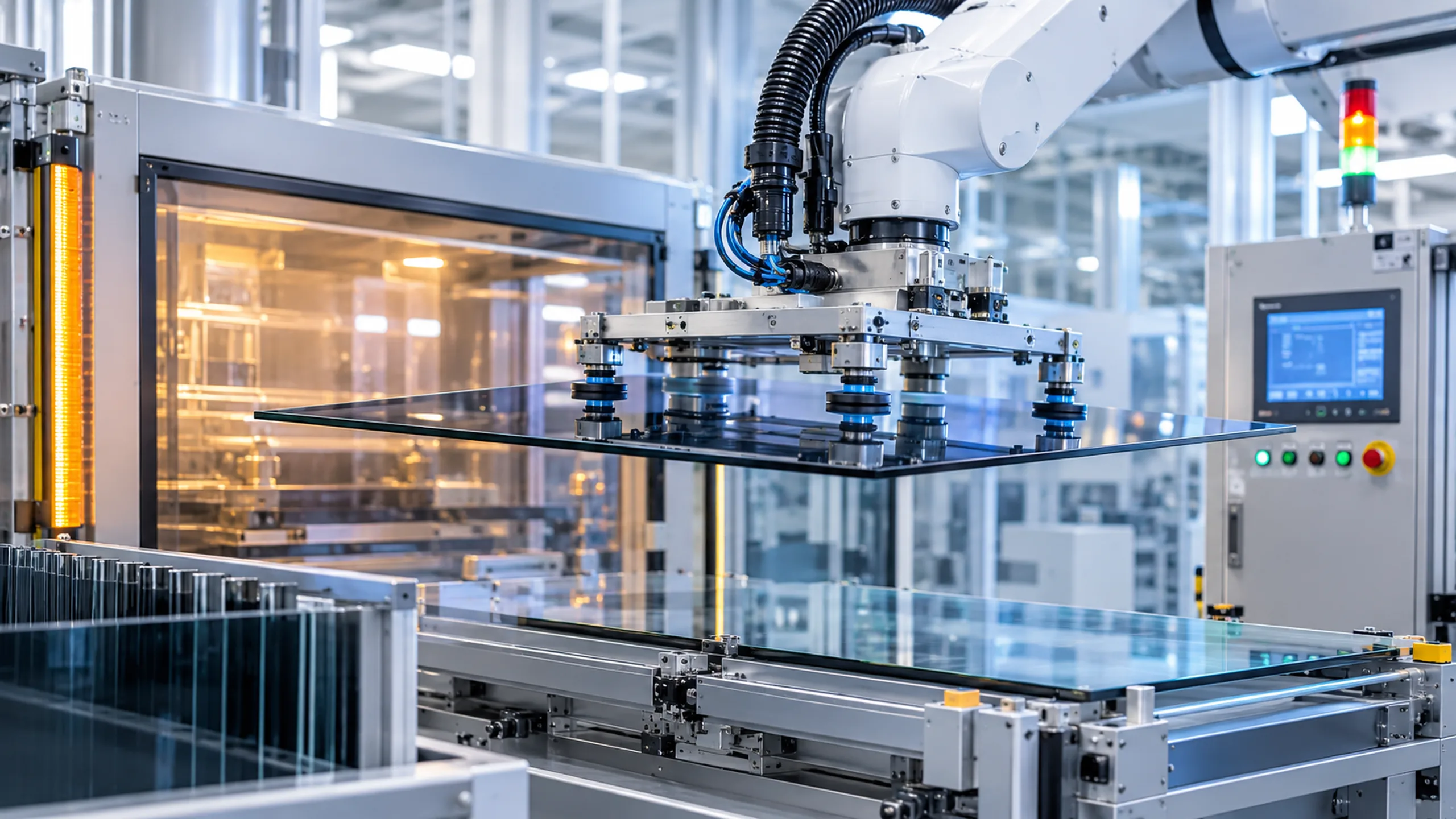
A recommendation, work-order request, or controller acknowledgment is not proof that a physical task has been completed. Each action needs a defined target, valid operating conditions, an authorized command path, and a way to verify what happened.
What the Physical AI Action Engine Does
The engine translates an approved action proposal into a controlled execution request for a specified asset or process. Before dispatch, the workflow checks whether the target is correctly identified, the equipment is in an eligible state, required permissions are present, and the requested action falls within its approved limits.
For display manufacturing, the relevant boundary may include panel and glass-substrate transfer equipment, robotic handling cells, conveyors, buffer stations, inspection stations, and the supervisory interfaces that coordinate them. The exact boundary depends on the facility, equipment configuration, and the task selected for evaluation.
The action engine does not replace a programmable logic controller (PLC), robot controller, machine safety system, or equipment manufacturer’s protective functions. It operates through validated supervisory interfaces and leaves low-level motion control and independent safety functions within their designated systems.
Display Manufacturing Actions to Evaluate
Potential use cases should be selected around a specific production workflow rather than treating all factory equipment as interchangeable. Examples for technical assessment include:
- Coordinating a robotic transfer of a glass substrate or display panel between a defined load, buffer, process, or inspection station.
- Requesting a panel move to a designated inspection or review position when an upstream quality decision requires additional examination.
- Routing an identified panel to an approved hold or reinspection location, subject to the facility’s quality rules and operator authorization.
- Requesting a bounded adjustment to material-handling equipment, such as a permitted transfer sequence or conveyor operation, when the equipment interface and process limits have been validated.
- Dispatching a mobile or robotic inspection task to a specified equipment area when the route, access conditions, and inspection procedure are approved.
These are candidate workflows, not statements that DisplayCore has already integrated or deployed the listed equipment functions. Selection requires confirmation of the facility’s equipment, control interfaces, operating rules, and production constraints.
Three Execution Modes
Human-mediated execution
The system presents an action proposal and the relevant context to an operator. The operator carries out the task using the established equipment controls, while the system records the request and any available completion evidence. This mode is appropriate when direct equipment control is unavailable, unvalidated, or outside the approved scope.
Human-approved commands
The system prepares a bounded command, checks its preconditions, and sends it for approval by an authorized operator or supervisor. Only after approval does the command proceed through the validated equipment interface. The approval record should identify the user, target, requested action, applicable limits, and command instance.
Bounded autonomous execution
A defined class of actions may execute automatically when the equipment state, target identity, operating conditions, permissions, and protective conditions all satisfy preapproved rules. The permitted action set must be narrow, testable, and subject to independent machine protections. If a precondition is unknown or invalid, the system should withhold dispatch and escalate for review.
Control Path: From Decision to Equipment
A practical control path separates the decision proposal from the equipment command and the observed result. A typical implementation may include the following stages:
- Action proposal: the AI Decision Engine or an approved business rule identifies a specific task, such as transferring a panel to a designated inspection station.
- Authorization: the workflow confirms the requesting identity, required approval, target asset, action scope, and time validity.
- Pre-dispatch validation: the system checks current equipment mode, target and destination identity, station availability, applicable interlocks, and the freshness and quality of the observations used to authorize the action.
- Command dispatch: a validated gateway or interface passes the supervisory request to the relevant PLC, robot controller, or equipment control interface.
- Command acknowledgment: the receiving system reports whether it accepted or rejected the request. Acceptance is recorded as an acknowledgment, not as proof of completed movement.
- Independent outcome check: subsequent equipment-state, position, presence, or identification observations are compared with the requested end state.
- Exception handling: a timeout, rejection, partial move, unexpected state, or missing verification result is recorded and routed to the designated operator or recovery procedure.
The interface may use a gateway, controller connection, or robotic interface, depending on the equipment. Specific protocols, vendors, and compatibility must be assessed for each installation. An interface should not be described as supported until it has been tested in the intended operating conditions.
Safeguards for Panel Handling and Equipment Control
Display panels and glass substrates can be vulnerable to handling damage, contamination, misalignment, and incorrect routing. Physical action therefore requires controls that reflect the material, equipment, cleanroom conditions, and consequences of an incorrect move.
- Role-based permissions should limit who can request, approve, modify, or cancel each action class.
- Preconditions should confirm panel or substrate identity, source and destination, equipment mode, station availability, and the validity of relevant sensor observations.
- Equipment interlocks, emergency stops, guarding, and other independent protective functions must remain under the authority of the designated machine and safety systems.
- Manual override and a defined stop or recovery procedure should remain available to authorized personnel.
- If communications are lost, acknowledgments are delayed, or observations become stale, the workflow should not assume that the command succeeded. It should follow the equipment-specific safe response and raise an exception.
- Rejected commands, duplicate requests, expired approvals, and partial execution should be logged with enough context for investigation.
AI-generated recommendations must not bypass validated equipment limits or independent safety functions. A software demonstration, simulation, or successful message exchange does not establish that a physical installation is safe, commissioned, or certified.
A Display-Panel Transfer Workflow
Consider a proposed workflow in which a panel is selected for additional inspection after a quality review. The action proposal identifies the panel, its current station, the requested inspection destination, and the reason for the move. Before dispatch, the system checks the panel identity, destination availability, equipment mode, current position, and required approval.
Verifying Execution and Measuring Performance
Action records should connect the original decision with authorization, dispatch, equipment response, and the observed physical outcome. A useful record may include an asset or panel identifier, event timestamp, observation timestamp, action type, source and destination, authorization reference, command identifier, controller acknowledgment, verification source, result status, and exception details.
Evaluation should compare the candidate workflow with a credible existing process under representative operating conditions. Useful measures include:
- Verified action rate: actions confirmed by independent outcome evidence divided by eligible attempted actions.
- Transfer completion and placement accuracy, measured against independently confirmed destination and position records.
- Command rejection, timeout, duplicate-request, and partial-execution rates.
- Time from approved request to verified completion, with the measurement window defined.
- Operator interventions, exception-resolution time, and recovery behavior.
- Constraint violations, including attempts made with invalid equipment state, unavailable destinations, or insufficient authorization.
Report unsuccessful and adverse outcomes as well as successful actions. Define the denominator, operating period, exclusions, and verification source for each measure. Do not treat command acceptance as a completed action or infer reduced damage, higher throughput, or improved yield without an evaluation that measures those outcomes.
Explore Related Capabilities
Discuss a display manufacturing workflow with DisplayCore. Share the equipment class, action to be evaluated, available interfaces, operating constraints, and the evidence your team would require to approve a pilot.