
DisplayCore AI Decision Engine for Display Manufacturing
The DisplayCore AI Decision Engine is the decision-support function within a Physical AI and Artificial Intelligence of Things (AIoT) workflow. It uses physical-world observations and production context to help display manufacturers interpret anomalies, assess risk, compare options, and determine when a human review is required. Each decision function needs defined inputs, an understandable output, evaluation criteria, and a clear boundary on how its output may be used. Specific models, data connections, and operating interfaces must be evaluated against representative site data before use.
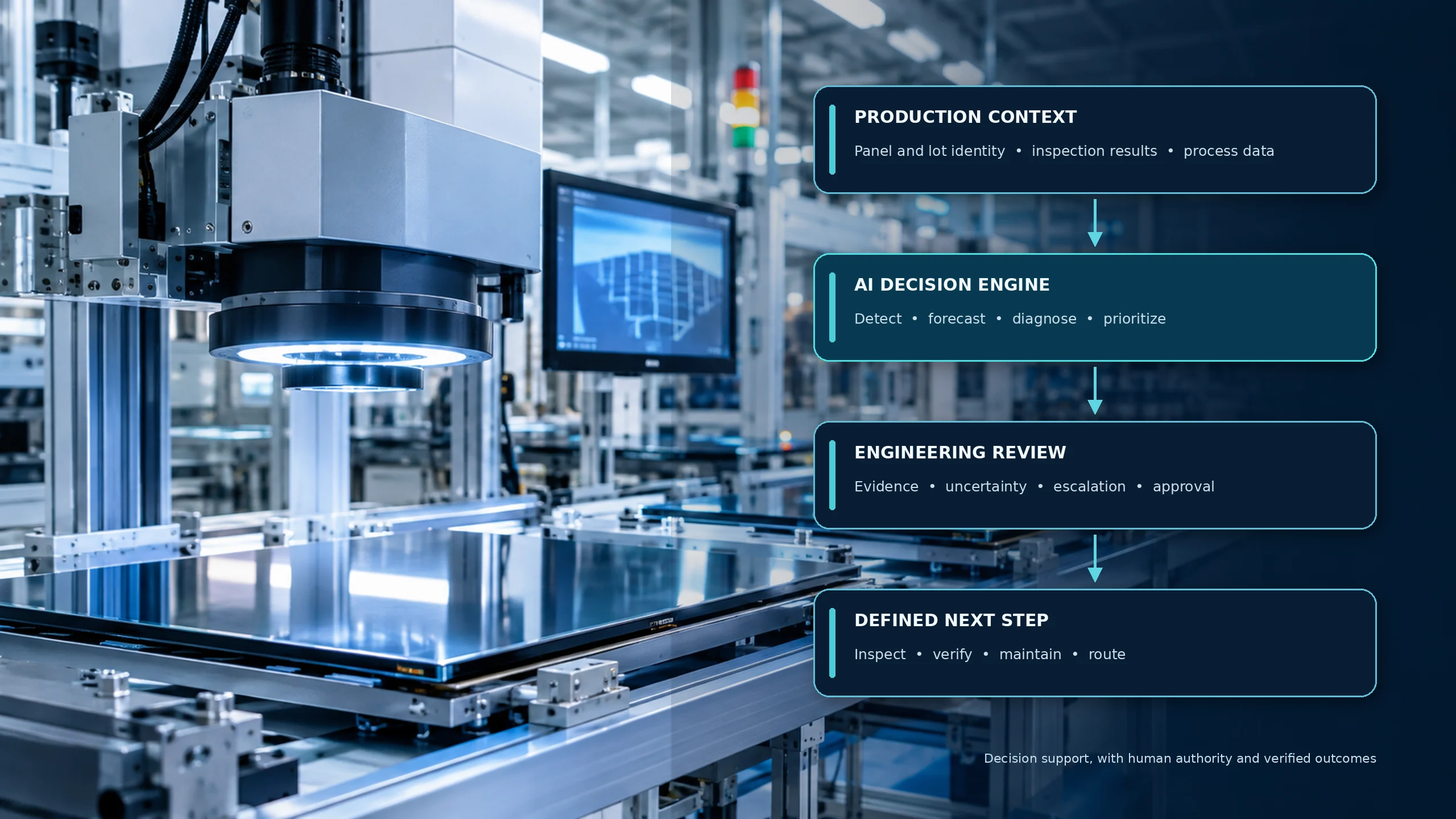
How the decision engine fits display manufacturing
Display manufacturing decisions depend on more than a single sensor reading or inspection result. A panel, substrate, or module has an identity and production history. Its condition may be assessed at multiple inspection or test points, while equipment state, process settings, product configuration, and production priorities provide context. The decision engine brings relevant records together so a process engineer, quality engineer, or production manager can evaluate what happened and choose an appropriate next step.
The engine sits between identification and sensing functions and the applications or authorized actions that use their outputs. It can support analysis and recommendations, but it does not make an uncertain inference equivalent to a confirmed defect, a verified root cause, or an approved process change.
Manufacturing data and operating context
Decision quality depends on the context attached to each observation. Candidate inputs for a display-manufacturing workflow include:
- Panel, glass substrate, display module, production lot, work order, and equipment identifiers.
- Automated optical inspection (AOI) findings, visual inspection records, metrology results, and functional test outcomes.
- Time-stamped equipment and process observations, including units, operating mode, and data-quality flags.
- Product configuration, process recipe, production line, station, and relevant operating limits.
- Historical quality outcomes, defect and disposition records, maintenance history, and engineering notes.
- Production schedule, equipment availability, approved quality rules, and escalation criteria.
Potential source systems include a Manufacturing Execution System (MES), inspection and test systems, equipment data collectors, quality applications, and maintenance records. These are candidate data sources, not assumed existing connections. Integration planning must confirm data ownership, access permissions, identifier mapping, timestamp alignment, sampling frequency, retention, and interface compatibility. Missing, delayed, duplicated, or unreliable observations should be identified before they influence a decision.
Decision functions for display manufacturing
The engine can be configured around one or more decision functions. Each function should state what it evaluates, what it returns, where uncertainty remains, and how its performance will be measured.
| Decision function | Display manufacturing question | Typical output | Evaluation focus |
|---|---|---|---|
| Anomaly detection | Identify departures in inspection patterns or equipment and process observations. | Flagged event, deviation indicators, affected panel, lot, or tool, and supporting context. | Recall, false-alert rate, detection delay, and performance across products, recipes, and operating modes. |
| Prediction and forecasting | Estimate whether a measured trend may cross a reviewed limit or create a near-term quality or equipment risk. | Risk estimate or forecast with a stated horizon, uncertainty, and relevant input history. | Forecast error, calibration, warning horizon, and performance by product or recipe. |
| Diagnosis and root-cause analysis | Rank process steps, equipment conditions, or material factors that engineers may need to investigate. | Ranked candidate explanations with the observations that support each one. | Agreement with engineer-confirmed findings, investigation time, and unresolved-case rate. |
| Risk prioritization | Order panel lots, inspection findings, or equipment events for review based on defined severity and operating context. | Prioritized review queue with reasons, evidence, and escalation indicators. | Relevance of top-ranked cases, missed high-severity events, and review workload. |
| Optimization and recommendations | Compare feasible inspection, maintenance, or routing options against approved quality, capacity, and schedule constraints. | Ranked alternatives with trade-offs and the constraints considered. | Baseline comparison, constraint violations, recommendation acceptance, and observed outcomes. |
For every selected function, document the input population, output format, uncertainty, operating limits, and owner responsible for reviewing the result.
Rules-based processing and machine learning
Rules-based processing applies explicit thresholds, process limits, eligibility conditions, and business rules. Machine learning (ML) identifies patterns in historical and current data or estimates an outcome from examples. A combined approach may use rules to enforce hard constraints and determine when a case is eligible for analysis, then use ML to detect patterns or rank risk for review.
A model recommendation must not override approved process limits, equipment interlocks, or independent protective functions. A suggested cause is a hypothesis for investigation, not a validated causal conclusion. Evaluations should include a simple rule-based baseline so the value of a more complex method can be assessed against a credible existing approach.
Two illustrative decision workflows
The following examples describe possible display-manufacturing workflows for evaluation. They clarify where decision support may fit; they are not claims of a completed deployment, a production-ready model, or an existing equipment connector.
1. Display panel inspection and quality review
An AOI station or a manual inspection process records a potential surface, alignment, contamination, or assembly-related finding. The decision workflow associates the finding with the correct panel or lot and retrieves relevant product, process, and prior inspection context. The engine may group similar events, compare the observation with reviewed patterns, and rank the case for quality review. The output should show the affected identifier, inspection evidence, relevant process context, uncertainty, and reason for its priority. A quality engineer then determines whether additional inspection, a hold for evaluation, or another approved disposition step is appropriate.
2. Equipment condition and process anomaly review
A selected production tool or station generates time-stamped operating measurements and equipment state records. The workflow associates those observations with the active product configuration, process recipe, operating mode, and maintenance history. The engine compares current behavior with an established baseline and can flag unusual changes for process or maintenance review. It may return the affected tool, time window, relevant signals, candidate contributing conditions, and recommended checks. A responsible engineer confirms the diagnosis and decides whether an inspection, maintenance request, or approved process response is warranted.
Evaluation, uncertainty, and human review
Evaluation should begin with a documented baseline, representative test cases, and acceptance criteria defined before results are reviewed. The baseline may be an existing threshold, a statistical process control rule, or the current engineering review process. Test data should reflect the product families, equipment, recipes, shifts, and operating conditions in the intended scope. Where practical, separate development and evaluation data by time, tool, lot, or operating condition to reduce information leakage.
- Anomaly detection: detection recall, false alerts per operating hour or production lot, and time to detect.
- Prediction and forecasting: forecast error, calibration, stated prediction horizon, and performance by product or recipe.
- Diagnosis: agreement with engineer-confirmed findings, investigation time, and the frequency of unresolved cases.
- Risk prioritization: relevance of the highest-ranked cases, missed high-severity events, and review workload.
- Recommendations: comparison with the baseline, constraint violations, engineer acceptance, and observed outcomes.
Results should identify the test population, exclusions, operating conditions, model version, and known limitations. Monitor for data drift, sensor changes, new products or recipes, and changes in equipment behavior. If observations are stale, data quality is inadequate, confidence is insufficient, or the operating state falls outside evaluated conditions, the engine should abstain or escalate the case for human review rather than present an unsupported answer.
Decision outputs and authority boundaries
Decision outputs should be matched to the responsibility of the receiving user and the authority of the surrounding system. Depending on the approved workflow, outputs may include:
- Dashboards and event summaries that show current status and relevant history.
- Ranked alerts or risk scores with supporting evidence and uncertainty.
- Recommendations for additional inspection, engineering investigation, or maintenance review.
- Workflow or work-order requests submitted to an existing business process.
- Action proposals that can be considered by a separate, authorized control workflow.
A recommendation is not an approved process change. A workflow request is not direct physical control. Any equipment adjustment or other physical response requires a defined target, authorization, validated interface, operating limits, and a method to check the resulting physical state. Command acknowledgment alone does not establish that the intended outcome occurred.
Plan an evaluation around your production workflow
A useful first step is to select one decision with a clear owner and a measurable operational question. Define the equipment or product scope, available records, current decision process, constraints, baseline, and the result that would make a pilot worth continuing. Review the quality and timing of the source data before selecting an algorithm. The right starting point may be a transparent rule, an anomaly-detection method, a forecasting model, or a ranked recommendation, depending on the evidence available.
Discuss your display manufacturing workflow with DisplayCore to define the data requirements, decision boundary, evaluation plan, and integration questions for a focused assessment.
Related resources
Discuss your display manufacturing workflow
Define a focused decision use case, review the available production data, and agree on an evaluation plan.