
Identification, Sensing, and State Estimation Research for Display Manufacturing
Reliable manufacturing decisions depend on knowing which product or asset is being observed and what condition it is in. Display manufacturing adds demanding requirements: fragile glass substrates and panels move through tightly controlled processes, while inspection and process equipment produce observations that may be incomplete, delayed, or affected by operating conditions. DisplayCore’s research adaptation examines how identification, sensing, and state estimation can help connect these observations to a more reliable view of production activity.
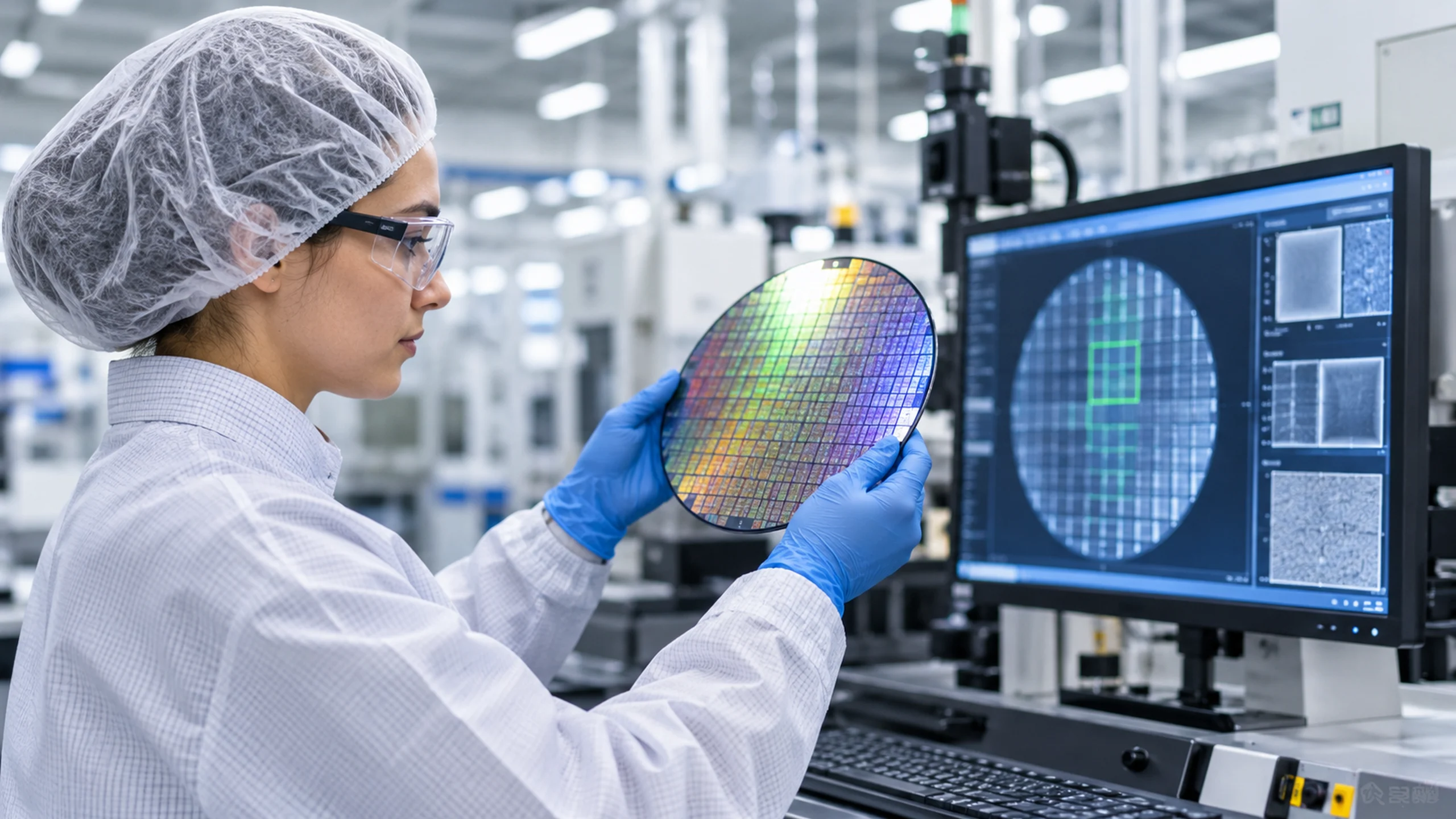
Connecting Identity, Measurements, and Manufacturing State
A display panel’s identity, process history, location, and measured condition are related, but they are not interchangeable. A reader event may indicate that a tagged carrier passed a station; it does not by itself prove that the intended panel was processed or that a transfer completed correctly. Likewise, an inspection image can reveal a visible feature without fully describing the panel’s process state.
Research questions include how to combine identification events, location signals, sensor measurements, and production records while preserving uncertainty. Candidate methods may associate observations with panel, substrate, carrier, tool, and process-step records; reconcile event time with ingestion time; and estimate current state from partial evidence. Data interfaces and use of Manufacturing Execution Systems (MES) or other plant systems depend on the facility’s existing architecture and must be assessed rather than assumed.
Sensor Reliability, Placement, and Data Quality
Display production environments can introduce reflection, occlusion, vibration, temperature variation, electromagnetic interference, and restricted sensor placement. Research can assess sensor suitability and placement, sampling intervals, calibration needs, time synchronization, and active perception strategies that select an additional observation when the current evidence is insufficient.
Data quality methods should account for missing, duplicated, stale, or conflicting observations, as well as sensor drift and device-health signals. The state-estimation process should distinguish directly measured values from inferred conditions and should be able to flag uncertainty or request review instead of forcing a definitive conclusion.
Traceability, Product Genealogy, and Custody Events
Traceability research can connect panel or substrate identity with production steps, inspection results, equipment associations, and custody records. Relevant questions include how to maintain product genealogy when reads are missed, how to resolve conflicting associations, and what evidence is needed to confirm a handover between process areas.
Radio-frequency identification (RFID) and real-time location systems (RTLS) may contribute identity or location observations where appropriate. Their role depends on the physical layout, material handling method, read environment, and information requirement. Research should not assume a technology is suitable for every display line or that a location observation guarantees a completed transfer.
Emerging Identification and Perception Methods
Where the operating requirements justify investigation, candidate topics include battery-free RFID, backscatter sensing, and energy harvesting. Their relevance depends on device placement, read range, available energy, data needs, and the display manufacturing environment. These approaches should be treated as research options until their practical fit is established.
Radar, thermal, and event-based perception may also be assessed for conditions where conventional optical observations are degraded by darkness, dust, occlusion, or other constraints. Research should define the actual sensing problem first, then compare modalities using representative conditions. These methods are not presumed to be active DisplayCore capabilities.
Proposed Demonstration and Evaluation
A proposed demonstration could model a panel or carrier handover, or an inspection workflow, in which observations are missing, conflicting, delayed, or degraded. The baseline could use a straightforward single-source association or rule-based state estimate. A candidate method could combine identity events with selected sensor inputs and process context. The scenario should define its asset classes, process boundary, operating conditions, data sources, and assumptions before testing.
Evaluation measures may include:
- Identity-association error and location error
- Required-event completeness and false associations
- State-estimation error by operating condition
- Processing latency and recovery after missing or degraded observations
- Energy use where relevant to the selected sensing approach
The demonstration should keep modeled ground truth separate from algorithm inputs and report results by operating condition. If synthetic data is used, findings must be identified as simulated and must not be presented as field performance. Physical validation remains necessary to assess sensor behavior, installation effects, integration, and operational response.

Research Status and Limitations
This page describes an industry-specific research direction, not a claim that each method has been implemented, demonstrated, or deployed by DisplayCore. The shared research initiative is attributed to Aperture Venture Studio, GAO RFID Inc., and GAO Tek Inc.; shared work must be distinguished from DisplayCore-specific activity. No company-specific research staffing, product readiness, measured results, or customer deployment is asserted here. Status and evidence should be updated only after technical review.
Research outcomes will depend on the selected display process, sensor configuration, data availability, environmental conditions, integration interfaces, and validation method. A successful simulation or controlled test does not establish production performance.
Related Research and Technical Resources
Discuss a Display Manufacturing Research Question
DisplayCore welcomes technical discussions about identification, sensing, traceability, and state-estimation challenges in display manufacturing. A useful starting point is a defined workflow, the assets or process steps involved, available observations, and the conditions under which those observations become unreliable.