
Matching the Right Wireless Technology to the Right Display Fab Use Case
RFID, BLE, UWB, cellular, LoRaWAN, and sensor technologies, each paired with AI models tuned to display fab conditions
Contact Us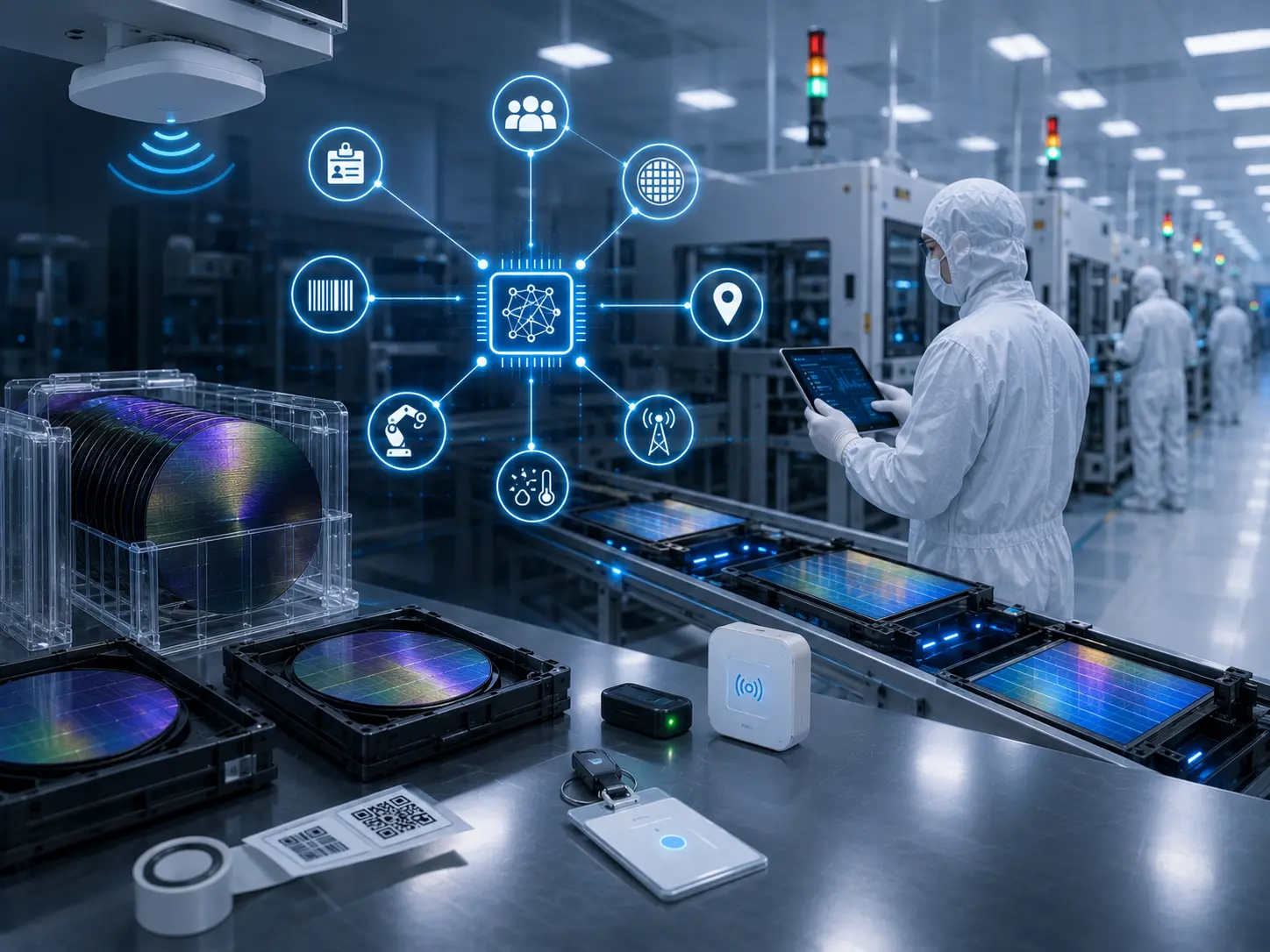
Overview
No single wireless technology covers every tracking requirement in a display fab. Reticle and photomask management calls for short-range, high-precision identification, while personnel tracking across a large cleanroom footprint requires broader zone-level coverage, and remote fab site inventory visibility depends on cellular or LoRaWAN connectivity rather than a local RFID network. DisplayCore AI pairs each identification and sensing technology with AI models tuned to the accuracy, range, and environmental requirements of its specific use case.
IoT Devices for Display Fab Operations
The physical device layer includes tags, readers, gateways, and sensors deployed throughout cleanroom, panel line, and storage environments.
RFID tags for reticles, photomasks & tooling carriers
Passive and active tags designed for cleanroom-compatible attachment to high-value production assets.
UWB & BLE personnel badges for cleanroom workers
Gowned-environment-compatible badges providing zone-level or precision location tracking depending on use case.
Fixed RFID readers for panel line entry/exit points
Infrastructure-mounted readers capturing panel and cassette movement at key transition points.
BLE gateways for display substrate & equipment tracking
Network infrastructure relaying location events from substrate and equipment tags to the data processing layer.
Industrial IoT sensors for environmental monitoring in fabs
Sensors monitoring temperature, humidity, and particulate conditions across cleanroom zones.
Barcode & QR scanners for panel-level traceability
Scanning infrastructure supporting serialization and genealogy tracking at manual and automated process stations.
AI + RFID for Display Manufacturing
RFID remains the foundation for most asset and material tracking in display fabs, and AI models extend its value beyond simple presence detection.
AI + UHF RFID for substrate & carrier cassette tracking
Scalable, longer-range identification suited to tracking substrate cassettes across large panel line areas.
AI + HF RFID for reticle & photomask management
Shorter-range, higher-precision identification suited to the tight tolerances required for reticle and photomask handling.
RFID-enabled AI access control at cleanroom airlocks
Access decisions combining RFID credential reads with AI-based role and certification verification.
AI + RFID for panel-level inventory count automation
Automated cycle counting for panel and substrate inventory, reducing manual counting labor and count discrepancies.
AI + BLE for Display Fab Environments
BLE technology supports continuous, zone-level tracking across cleanroom and panel line areas where RFID’s shorter range is less practical.
AI + BLE for real-time worker location in cleanrooms
Continuous zone-level personnel tracking across multi-bay cleanroom facilities.
BLE-based personnel tracking with AI zone classification
Models that classify personnel location into specific process zones for compliance and density monitoring.
AI + BLE for WIP container monitoring on panel lines
Tracking of WIP containers and carriers as they move along panel production lines.
BLE beacon networks for multi-zone fab navigation
Beacon infrastructure supporting navigation and location awareness across large, multi-zone fab facilities.
AI + UWB & Cellular for Panel Operations
Where sub-meter accuracy or connectivity beyond a single facility is required, UWB, cellular, LoRaWAN, and GPS technologies extend DisplayCore AI’s tracking capability.
AI + UWB precision tracking for critical equipment & assets
Sub-meter location accuracy for high-value tooling and equipment requiring precise positioning.
AI + cellular IoT for remote fab site inventory visibility
Connectivity supporting inventory tracking at facilities without dedicated local network infrastructure.
AI + LoRaWAN for environmental sensor monitoring in fabs
Long-range, low-power connectivity for environmental sensors distributed across large facility footprints.
AI + GPS for inter-facility display panel shipment tracking
Location tracking for panel and material shipments moving between manufacturing sites.
AI + IoT Sensors for Process Monitoring
Beyond location tracking, sensor-based monitoring supports cleanroom compliance, equipment health, and product quality objectives.
AI + environmental sensors for cleanroom class compliance
Continuous monitoring of particulate, temperature, and humidity conditions against cleanroom classification requirements.
AI + vibration & thermal sensors for display equipment health
Predictive models built on vibration and thermal signatures to flag equipment health issues before failure.
AI + gas detection sensors for chemical exposure monitoring
Monitoring for chemical exposure risks in process areas using hazardous materials.
AI + vision systems for panel surface defect detection
AI-driven visual inspection identifying surface defects on panels moving through the production line.
U.S. AND CANADIAN STANDARDS AND REGULATIONS
Cleanroom & Environmental Standards
- ISO 14644-1 / -2 / -3 / -4 / -9: Cleanroom air cleanliness, performance monitoring, test methods, design/construction, and surface cleanliness.
- IEST-RP-CC006 / -CC034: Cleanroom testing and HEPA/ULPA filter leak tests.
ESD Control Standards
- ANSI/ESD S20.20 & IEC 61340-5-1 / -5-2: Electrostatic discharge protection for electronic components and devices.
- ANSI/ESD STM1.1 & JEDEC JESD22-A114: ESD sensitivity testing (Human Body Model).
SEMI Standards
- SEMI E10 & E58: Equipment reliability, availability, and maintainability (RAM).
- SEMI E30 (GEM) & E37 (HSMS): Communication and control protocols.
- SEMI E40, E42, & E94: Process, recipe, and control job management.
- SEMI E87 (CMS) & E90: Carrier management and substrate tracking.
- SEMI E116 & E187: Equipment performance tracking and fab cybersecurity.
- SEMI G81: Digital watermarking for semiconductor equipment data.
Material Composition & Substance Regulations
- TSCA (US) & CEPA / CMP (Canada): Toxic substance control and chemical management.
- California Proposition 65: Safe drinking water and toxic enforcement.
- RoHS Directive & REACH Regulation: Global hazardous substance and chemical restrictions.
Automotive Display & Traceability Standards
- IATF 16949: Quality management for automotive production.
- AEC-Q100 & AEC-Q200: Stress test qualifications for active and passive components.
- ISO 26262: Functional safety for road vehicles (display panel traceability).
- AIAG FMEA Manual: Failure Mode and Effects Analysis.
Safety & Occupational Health Regulations
- OSHA 29 CFR 1910.1000 & 1910.119: Air contaminants and Process Safety Management (PSM).
- NFPA 318 & NFPA 70: Semiconductor fab protection and the National Electrical Code.
- SOR/86-304: Canada Occupational Health and Safety Regulations.
Data Privacy & Cybersecurity Regulations
- NIST SP 800-53 & 800-82: Information system controls and Industrial Control Systems (ICS) security.
- IEC 62443: Industrial cybersecurity standards series.
- PIPEDA (Canada) & CCPA (California): Data privacy and personnel tracking protection.
IoT & Wireless Communication Standards
- FCC Part 15 & ISED RSS-247: US and Canadian radio frequency/license-exempt apparatus regulations.
- IEEE 802.15.4 / .4a / .4z: Low-rate wireless and Ultra-Wideband (UWB) physical layers.
- ISO/IEC 18000 Series / 15693 / EPC Gen2: RFID air interface and protocol standards.
TOP PLAYERS
RFID Hardware & Software
- Zebra Technologies / Impinj / Alien Technology: UHF RFID chips, readers, and scanners.
- HID Global / CAEN RFID / CSL: HF/UHF hardware and access control.
- Brady / Confidex / Metalcraft: Cleanroom-compatible, on-metal, and durable industrial RFID labels.
RTLS (BLE & UWB Location Systems)
- UWB Specialists: Sewio, Ubisense, Pozyx, Inpixon
- BLE Specialists: CenTrak, Quuppa (AoA), Redpoint Positioning
- Enterprise RTLS: Zebra MotionWorks
Industrial IoT Sensors & Environmental Monitoring
- Cleanroom Particle Tracking: Particles Plus, TSI Incorporated, Vaisala
- Gas & Process Sensors: Honeywell Analytics, Emerson Automation, Yokogawa
- SCADA & Automation Sensors: Siemens
MES, ERP, & Fab Execution Systems
- Applied Materials (Applied SmartFactory MES)
- Brooks Automation (FAB300 MES)
- Yield Management AI: Camtek, KLA Corporation (Klarity), Onto Innovation (Discover AI)
- Enterprise ERP: SAP (S/4HANA), Oracle (JD Edwards)
Barcode, Serialization, & Traceability
- Laser Marking & Print: Videojet, Markem-Imaje, SATO Holdings
- Scanning & Machine Vision: Datalogic, Cognex (Panel inspection), Honeywell
Edge Computing & Infrastructure
- Hardware Systems: Dell, HPE (Edgeline), Advantech, Cisco
- Cloud-Edge Integration: AWS (Greengrass), Microsoft Azure (Azure IoT Edge)
United States Case Studies
RFID-Based Reticle Tracking at an LCD Array Fab (Hillsboro, OR)
Problem: An LCD array fab running Gen 8.5 production lines suffered from frequent reticle misplacement and wrong-reticle exposure errors across a 400-photomask library. This caused manual staging delays, process excursions, and lot-level yield loss.
Solution: Deployed cleanroom-compatible HF RFID tags on reticle pods alongside readers at stockers, handoff stations, and stepper loadports. An AI system tracked locations, monitored shot counts, predicted cleaning cycles, and verified reticle-to-layer assignments via MES integration.
Result: Eliminated wrong-reticle events within the first quarter, slashed reticle search times by 85%, and achieved 100% cleaning compliance.
BLE Personnel Tracking in OLED Cleanrooms (San Jose, CA)
Problem: An ISO Class 5 AMOLED fab lacked continuous personnel occupancy tracking. Lacking time-stamped logs, supervisors could not verify if two severe particle count excursions were caused by overcrowding in the deposition bays.
Solution: Integrated cleanroom-compatible BLE badges into the gowning protocol and deployed a real-time location system (RTLS) network across the bays. An AI zone-classification engine mapped worker locations and fed real-time occupancy dashboards with automated density alerts.
Result: Established full occupancy visibility within eight weeks, eliminated density threshold violations within three months, and mathematically correlated density reductions to lower particle counts.
UHF RFID Substrate Cassette Tracking at a Gen 10.5 LCD Fab (Phoenix, AZ)
Problem: Processing thousands of large-format glass cassettes weekly exceeded manual scanning capacities, causing automated material handling system (AMHS) routing errors. This created buffer imbalances, queue time violations, and contamination risks.
Solution: Installed fixed UHF RFID readers at transfer ports, stocker conveyors, and tool loadports, matching them to long-range UHF tags on cassettes. An AI analytics system monitored queue times and routing deviations, syncing data with SEMI E87 carrier management records.
Result: Reduced cassette routing errors by 91% in six months, eliminated photoresist queue time violations, and cut production reporting time by 60%.
AI Access Control for ESD-Sensitive Bonding Areas (Austin, TX)
Problem: Personnel frequently entered driver IC bonding areas without verifying their grounding wrist straps, leading to ESD-related defects, lot reworks, and internal quality audit failures.
Solution: Tied entry turnstiles to an AI access engine that cross-referenced RFID badge scans with real-time ESD wrist strap tester results and HR training certifications before unlocking doors.
Result: Reached 100% ESD zone access compliance within the first month, logged zero ESD bonding defects over the following year, and reduced audit preparation time by 70%.
AI Inventory Management for OLED Organic Materials (Boise, ID)
Problem: Manual tracking and fixed reorder points failed to account for environmental fluctuations or batch consumption rates, resulting in high-cost organic emitter and barrier chemicals expiring in cold storage vaults.
Solution: Deployed LoRaWAN environmental sensors in temperature-controlled vaults alongside RFID tags on material lots. An AI system merged real-time climate data with production schedules to predict dynamic expiry risks and automate ERP reorders.
Result: Eliminated organic material expiry waste over 12 months, reduced inventory holding costs by 22%, and cut response times for climate excursions down to hours.
Panel Genealogy Traceability for Automotive Display Supply (Detroit, MI)
Problem: Fragmented manual barcode scans left massive traceability gaps between array, cell, and module production steps, leaving the manufacturer unable to easily satisfy IATF 16949 audit demands or quickly isolate defective panels.
Solution: Implemented an AI genealogy system that linked AMHS RFID cassette events with workstation barcode scans. This formed a unified data pipeline connecting every module serial number to its raw substrate lot, process tools, and test history.
Result: Achieved 99.7% genealogy record completeness within two quarters, passed customer audits finding-free, and cut forward-trace query times from five days to under 30 seconds.
WIP Monitoring Across Array-to-Cell Process Transfer (Portland, OR)
Problem: Poor visibility into cassette dwell times within the inter-process buffer caused chronic queue time violations at liquid crystal injection stations, resulting in severe cell gap uniformity defects.
Solution: Combined UHF RFID tracking at buffer access points with stocker event logs. An AI queue analytics engine established individual dwell-time countdowns per lot, alerting dispatchers at 80% and 100% threshold limits.
Result: Cut queue time violations at injection stations by 96% and reduced cell gap uniformity defects by roughly 40%, saving supervisors four hours of manual checks per shift.
Personnel Flow Optimization in a Multi-Bay TFT Fab (Chandler, AZ)
Problem: Workers frequently crossed from wet chemical areas into dry photolithography bays without following transition protocols, creating severe chemical cross-contamination risks on photoresist-coated substrates.
Solution: Deployed zone-level BLE tracking for general cleanroom movement alongside high-precision UWB tracking at critical bay transitions. An AI engine flagged non-compliant routing paths in real time and compiled weekly trend logs.
Result: Decreased protocol-violating cross-bay movements by 88% within two months and recorded zero cross-contamination events over the following eight months.
Canadian Case Studies
RFID Asset Tracking for Display Fab Equipment (Waterloo, ON)
Problem: Researchers at a pilot production facility wasted significant time searching for shared, high-value metrology instruments and mobile test equipment scattered across multiple buildings, leading to inefficient capital procurement.
Solution: Tagged portable instruments with BLE beacons and fixed machinery with UHF RFID labels. An AI system consolidated these signals into live location maps, utilization dashboards, and idle asset reports.
Result: Reduced equipment search times by 74% and identified three underutilized metrology tools, allowing management to defer two major capital purchases by 18 months.
Cleanroom Access Control Deployment (Kanata, ON)
Problem: Customer quality audits continually flagged the assembly facility because its badge-only cleanroom entry gates lacked connection to live ESD training records or tester logs, leaving entry compliance unverified.
Solution: Integrated entry readers with the facility’s certification database and ESD wrist strap test units. An AI compliance engine automated the generation of customer-structured access logs for direct audit submission.
Result: Secured 100% compliance documentation from go-live, achieved zero findings on the subsequent supplier audit, and cut report preparation time from 16 hours to under two.
WIP and Inventory Tracking at a Display Panel Facility (Bromont, QC)
Problem: Periodic physical inventory counts generated severe stock discrepancies for color filters, polarizers, and optical adhesive (OCA) films, causing simultaneous material shortages and overstocking.
Solution: Monitored incoming, warehoused, and issued material roll stock using UHF RFID tags, while adding fixed barcode scanners at assembly workstations to track WIP status. An AI system unified these streams to feed real-time ERP replenishment data.
Result: Boosted inventory count accuracy to 98.6%, eliminated line-side material shortages, and captured 97% of WIP steps automatically to save three hours of manual reconciliation per shift.
Choosing the Right Technology Mix
Most display fab deployments combine several of these technologies rather than relying on a single wireless standard. RFID typically anchors asset and material tracking, BLE supports zone-level personnel and WIP visibility, UWB fills in where precision matters most, and cellular or LoRaWAN extends coverage to remote sites or large facility footprints. DisplayCore AI’s edge and software layers are designed to ingest and normalize data across this mixed technology environment, so the AI models operating on top do not need to be reconfigured each time a new device type or reader is added to the network.
Contact Us